
Spectrum-controlled farming uses precise light management to boost your crop yields and quality. By customizing LED spectra for different growth stages, you can enhance plant health, improve pigmentation, and accelerate development. Adjusting light wavelengths makes your plants more resilient and reduces resource waste. This innovative approach helps you achieve better results with less effort. To discover how this technology can transform your farming practices, explore the details further.
Key Takeaways
- Tailored light spectra enhance plant growth stages, increasing overall crop yields and accelerating production cycles.
- Optimized LED lighting improves photosynthesis efficiency and resource use, leading to higher productivity.
- Dynamic spectrum adjustments promote better pigmentation and crop quality, increasing market value.
- Precise environmental control minimizes stress and ensures uniform growth, boosting consistency and yields.
- Advanced visualization tools enable real-time monitoring and fine-tuning of light conditions for maximum output.
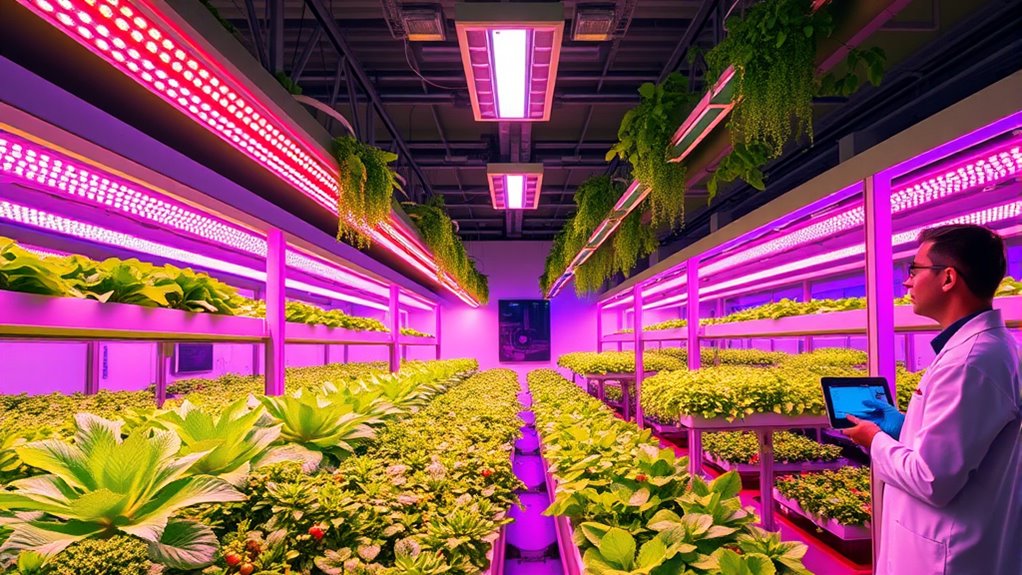
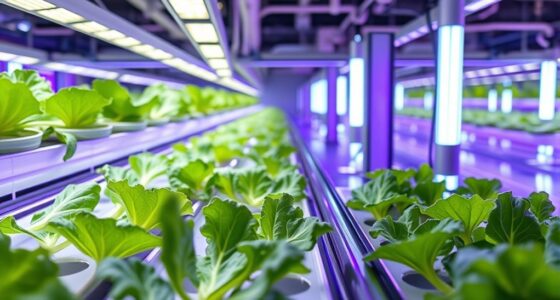
Spectrum-controlled farming is revolutionizing agriculture by allowing farmers to precisely manage light exposure and environmental conditions for their crops. This innovative approach leverages advanced lighting systems, particularly LED optimization, to create ideal growing conditions. By tailoring light spectra, you can influence various plant processes, leading to healthier, more productive crops. One of the key benefits of this technology is its ability to enhance crop pigmentation, which directly impacts the appearance, nutritional value, and marketability of your produce.
Spectrum-controlled farming uses tailored LED lighting to boost crop health and pigmentation, enhancing quality and market appeal.
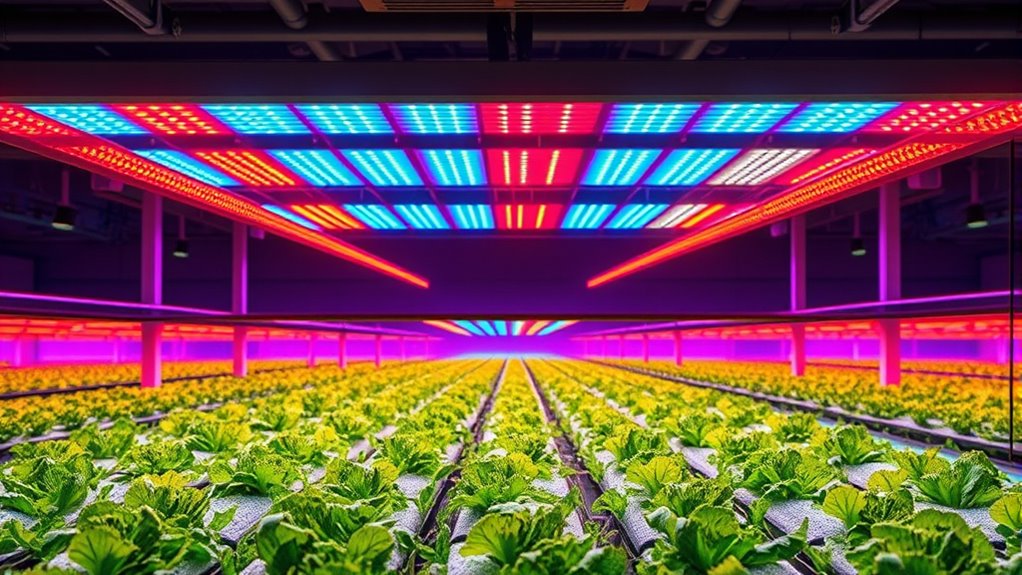
When you optimize LEDs for specific wavelengths, you give your crops the exact light signals they need during different growth stages. For example, during the vegetative phase, you might emphasize blue light to promote robust leaf development. As your plants shift to flowering or fruiting, shifting to red or far-red light can stimulate flowering and fruit production. This precise control accelerates growth cycles and improves yields, all while reducing energy waste by using only the necessary spectra.
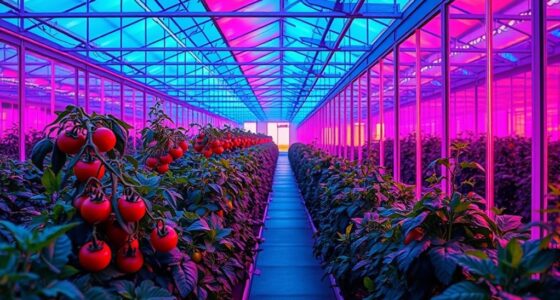
Crop pigmentation plays a vital role in both crop quality and consumer appeal. With spectrum-controlled farming, you can manipulate the production of pigments like chlorophyll, carotenoids, and anthocyanins. For instance, increasing specific wavelengths can boost the richness of red, yellow, or purple hues in fruits and vegetables. This not only makes your crops more visually appealing but also enhances their antioxidant content and nutritional profile. When you fine-tune LED settings to maximize pigmentation, you’re effectively enhancing the crop’s natural colors and health benefits, which can command higher market prices.
Moreover, spectrum-controlled systems enable you to respond dynamically to the needs of your crops. As environmental conditions change, you can adjust the light spectra in real-time, ensuring your plants always receive ideal exposure. This adaptability leads to better stress resilience and uniform growth across your fields or indoor farms. You’ll find that such precision management simplifies crop production, minimizes resource use, and maximizes output. Additionally, utilizing high contrast ratio projectors can help visualize and monitor your crop development in controlled environments, improving decision-making and efficiency.
LED grow lights for indoor plants
As an affiliate, we earn on qualifying purchases.
As an affiliate, we earn on qualifying purchases.
Frequently Asked Questions
How Does Spectrum-Controlled Farming Impact Plant Nutrient Absorption?
Spectrum-controlled farming enhances your plants’ nutrient absorption by optimizing photosynthesis efficiency. When you adjust light spectra, you activate specific nutrient uptake pathways, making them more effective. This targeted light improves overall plant health, leading to better nutrient assimilation. As a result, your crops grow stronger and yield more, because the precise light control guarantees plants utilize nutrients efficiently, boosting growth and maximizing productivity.
What Are the Initial Costs of Implementing Spectrum-Controlled Systems?
Starting spectrum-controlled farming costs can seem steep, but as you assess initial investments, you’ll find equipment and installation prices are the primary expenses. Maintenance costs usually remain manageable, focused on system upkeep and updates. While the upfront investment might be hefty, many growers find the long-term benefits—boosted yields and optimized growth—are well worth the initial outlay. Be prepared for initial costs, but stay optimistic about future gains.
Can Spectrum-Controlled Farming Be Used Outdoors Effectively?
Yes, spectrum-controlled farming can be effective outdoors, but it faces challenges like outdoor light variability. You can incorporate solar panel integration to power the systems sustainably, helping to adapt to changing light conditions. By using smart sensors, you can adjust light exposure in real-time, ensuring ideal growth. While outdoor use is promising, it requires careful planning to mitigate weather and natural light fluctuations for consistent results.
How Does Spectrum Control Influence Pest and Disease Management?
Did you know that spectrum control can reduce pest issues by up to 60%? It influences pest deterrence and disease suppression by using specific light wavelengths to make plants less attractive to pests and inhibit pathogen growth. You can actively manage pests and diseases without relying heavily on chemicals, promoting healthier crops. By adjusting light spectra, you create an environment that naturally deters pests and suppresses diseases, boosting overall plant health.
Are There Specific Crops That Benefit Most From Spectrum-Controlled Lighting?
You’ll find that crop varieties like leafy greens, herbs, and tomatoes benefit most from spectrum-controlled lighting. This technology allows you to customize light spectra to match each crop’s needs, promoting faster growth and better yields. By tailoring light conditions through light customization, you optimize photosynthesis and development, ensuring healthier plants. So, if you’re growing diverse crops, spectrum control helps you maximize each crop’s potential efficiently.
spectrum controlled LED lighting systems
As an affiliate, we earn on qualifying purchases.
As an affiliate, we earn on qualifying purchases.
Conclusion
By now, you see how spectrum-controlled farming can revolutionize your crop yields. Imagine increasing productivity by up to 30% just by adjusting light spectra! This innovative approach lets you optimize plant growth with precision, reducing waste and boosting efficiency. As technology advances, embracing spectrum-controlled farming could give you a competitive edge. Don’t miss out on this game-changing method—your farm’s future depends on harnessing the power of tailored light for healthier, higher-yield crops.
As an affiliate, we earn on qualifying purchases.
crop monitoring visualization tools
As an affiliate, we earn on qualifying purchases.
As an affiliate, we earn on qualifying purchases.