
Li-Fi is a revolutionary technology that uses light, like LED lamps, to transmit high-speed internet wirelessly. It encodes data by flickering light at imperceptible speeds, which your device decodes with a photodiode. This offers faster connections, better security, and avoids radio interference. However, it needs a direct line of sight and is less effective outdoors. To discover how this cutting-edge tech could change your online experience, keep exploring the details.
Key Takeaways
- Li-Fi uses visible light to transmit data by rapidly flickering LED lights at imperceptible speeds.
- Data is received through photodiodes that decode the modulated light signals.
- It offers high-speed internet with enhanced security due to confined light signals.
- Li-Fi requires a direct line of sight and is less effective outdoors with sunlight interference.
- It complements existing Wi-Fi technology, promising faster and more secure internet access through light.

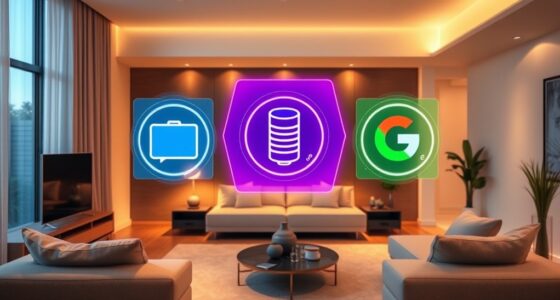
Ever wondered if your lightbulb could also connect you to the internet? It might sound like science fiction, but with Li-Fi technology, it’s becoming a reality. Li-Fi, short for Light Fidelity, uses light-based data transmission to deliver high-speed internet through visible light, ultraviolet, and infrared spectrums. Unlike traditional Wi-Fi, which relies on radio waves, Li-Fi utilizes wireless communication via light, offering a new way to stay connected. Imagine turning on your LED bulb and instantly accessing the internet—no wires, no fuss.
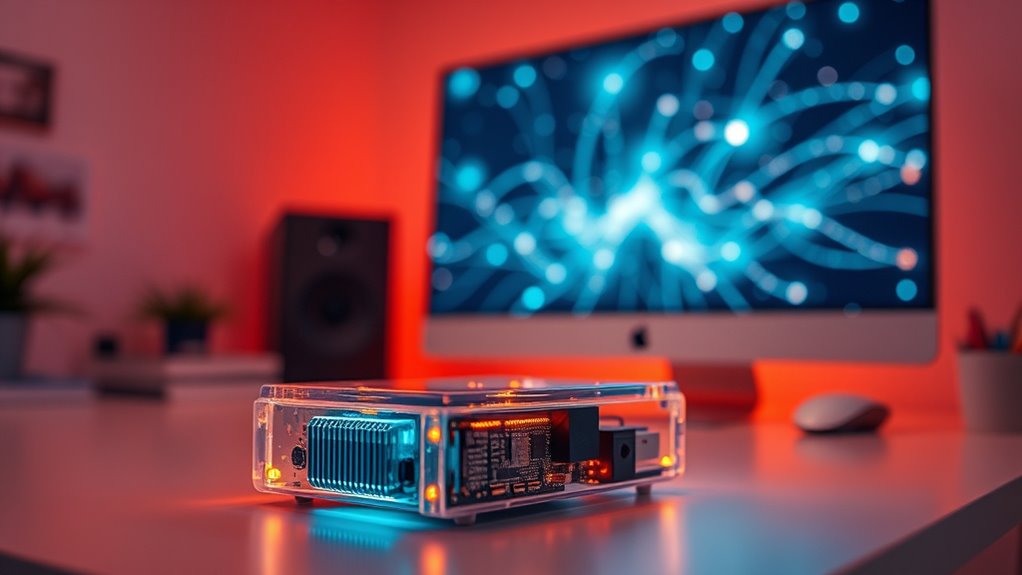
This innovative approach works by modulating the intensity of LED lights at a speed imperceptible to the human eye. When your lightbulb flickers rapidly, it encodes data that a receiver, like a photodiode, can decode into information. This method of light-based data transmission makes it possible to transmit large amounts of data at incredible speeds. Because light waves are much faster than radio waves, Li-Fi can potentially provide faster internet connections, especially in heavily populated areas or environments where radio frequency interference is a concern.
Li-Fi’s reliance on light for data transfer offers several advantages. First, since light doesn’t penetrate solid objects, it provides a high level of security. Your data stays confined within a room or area, reducing the risk of hacking from outside sources. Second, the spectrum of visible light is vast, allowing for more data channels than radio frequencies can provide, which means less congestion and faster speeds. Plus, light-based data transmission doesn’t interfere with electronic devices that rely on radio frequencies, making Li-Fi ideal for sensitive environments like hospitals or aircraft.
However, there are some limitations to account for. Li-Fi signals require a direct line of sight between the transmitter and receiver, so obstacles can block or degrade the signal. Also, it’s less effective outdoors where sunlight can interfere with the light signals. Despite these challenges, ongoing advancements are making Li-Fi more practical for everyday use. Researchers are developing hybrid systems that combine Wi-Fi and Li-Fi, ensuring seamless connectivity even when the light signal isn’t available.
In essence, your lightbulb might soon do more than illuminate your space—it could be your gateway to the internet through light-based data transmission. By leveraging wireless communication via light, Li-Fi promises faster, more secure, and more efficient internet access. As the technology matures, it could revolutionize how you connect, turning everyday lighting into a powerful network tool. Resources and tools are being developed to expand the potential applications of Li-Fi in various industries. So next time you flip on a light, think about the possibility that it might soon be connecting you to a smarter, faster internet.

Celestron StarSense Explorer 150AZ App-Enabled Telescope – 150mm Tabletop Dobsonian with Smartphone Dock & StarSense App – iPhone & Android Compatible – Easy-to-Use for Beginners
SMARTPHONE-POWERED SKY TOUR: No experience needed! Just dock your phone, launch the StarSense Explorer app, and follow the...
As an affiliate, we earn on qualifying purchases.
Frequently Asked Questions
Does Li-Fi Work Outdoors in Sunlight?
Li-Fi can work outdoors in sunlight, but solar interference might impact your outdoor signal strength. Bright sunlight can cause signal disruptions, reducing the effectiveness of Li-Fi connections. To improve performance, use specialized outdoor Li-Fi systems designed to handle strong ambient light. Keep in mind, the outdoor environment requires more robust equipment and positioning to ensure a reliable connection despite solar interference.
Can Li-Fi Replace Wi-Fi Entirely?
Imagine light-based communication as a new dawn in wireless technology evolution, promising faster connections. While Li-Fi can supplement Wi-Fi, it can’t replace it entirely yet. Its dependence on direct line-of-sight and light conditions limits outdoor use. To truly revolutionize, it needs to overcome these hurdles. So, for now, think of Li-Fi as a powerful partner enhancing your wireless world, not a complete replacement.
How Secure Is Li-Fi Compared to Wi-Fi?
Li-Fi is generally more secure than Wi-Fi because light interception requires a direct line of sight, making hacking risks lower. You have to be physically close to the light source to access the data, reducing remote hacking possibilities. However, if someone gains access to the light pathway, they could intercept data. So, while it offers increased security, it’s not entirely immune to security threats, especially if the light signals aren’t properly encrypted.
What Devices Are Compatible With Li-Fi?
You might think only sci-fi gadgets can connect, but surprisingly, many devices like smartphones, laptops, and tablets are compatible with Li-Fi, provided they have the right device requirements—namely, a built-in photodetector or an add-on receiver. If your device has the right hardware, you’re all set. Just remember, compatibility depends on device requirements, so check before you jump into this dazzling new world of internet through light.
What Are the Costs of Implementing Li-Fi?
Implementing Li-Fi involves a cost analysis that considers device upgrades and infrastructure. You’ll face deployment challenges like installing compatible LED lighting and ensuring ideal placement. The initial setup can be pricey, especially for large-scale deployment, but ongoing costs are lower due to energy efficiency. While the technology offers benefits like high speed and security, you should weigh these against potential costs and challenges to determine if Li-Fi suits your needs.

Sky-Watcher Classic 200 Dobsonian 8-inch Telescope – Solid-Tube – Simple, Traditional Design – Easy to Use, Perfect for Beginners, White (S11610)
LARGE APERTURE: Get a bright, bold viewing experience at a fraction of other optical designs.
As an affiliate, we earn on qualifying purchases.
Conclusion
You might worry that Li-Fi’s reliance on light could limit your internet access, especially indoors or during cloudy days. But with advancements in technology, Li-Fi can seamlessly switch between light and traditional Wi-Fi, ensuring you stay connected anytime. Embracing Li-Fi means enjoying faster, more secure internet, even in crowded spaces. Don’t let concerns hold you back—this innovative tech is ready to light up your digital world and make your online experience smoother than ever.

VTOMAN Jump 600X Portable Power Station 600W, 299Wh Solar Generator LiFePO4 Battery Power Station with Jump Start for Car, 1200W AC Outlet, PD 60W USB-C, 3x Regulated 12V/10A DC for Camping, RV Travel
【2-in-1 Portable Station & Car Jump Start】Never face a dead battery alone! VTOMAN Jump 600X combines a 299Wh...
As an affiliate, we earn on qualifying purchases.

AFERIY 3840Wh Portable Power Station,120V AC Outlets x 5,2.5H Fast Charge,3600W(Peak 7200W),LiFePO4 Battery Power Station,Solar Generator for Home,Outdoor Camping,Power Outage,Camping,RV,Emergencies
【Up to 30% Tax Credit】Eligible solar-related purchases may qualify for the U.S. Residential Clean Energy Credit. Eligibility and...
As an affiliate, we earn on qualifying purchases.