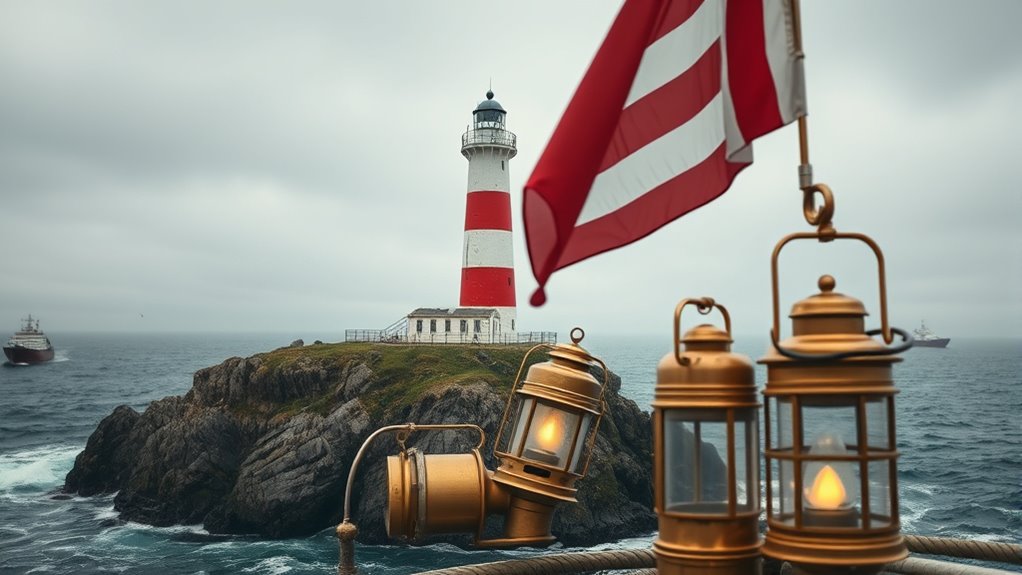

Lighthouses and maritime signaling are essential for your safe navigation at sea. They serve as visual beacons, guiding you through hazardous waters, with distinctive lights, colors, and flash patterns that help you identify your location and safe routes. In foggy conditions, sound signals like foghorns and radio messages provide extra layers of safety. Understanding these signals can improve your navigation skills, and if you keep exploring, you’ll discover even more about how these systems work together to keep you safe.
Key Takeaways
- Lighthouses serve as visual navigation aids with distinctive light patterns to identify safe routes and warn of hazards.
- They utilize unique light signals, colors, and flashing sequences for mariner recognition and route confirmation.
- Additional signaling methods like foghorns and radio signals enhance safety during poor visibility conditions.
- Recognizing lighthouse signals helps mariners verify their position and make informed navigation decisions.
- Lighthouses act as safety symbols, providing continuous guidance and supporting maritime safety systems.

Lighthouses have long served as crucial beacons for ships steering treacherous waters, guiding sailors safely toward harbor and away from danger. They stand tall against the skyline, their lights piercing the darkness to mark safe passages and alert vessels to hazards. As part of maritime signaling, lighthouses act as vital navigational aids, especially before the advent of modern electronic systems. When you’re navigating busy or rocky coastlines, these structures provide visual cues that help you determine your position and course. Their distinctive light patterns, or characteristic signals, are designed so that mariners can identify specific lighthouses from afar, even in fog or poor visibility. This signal communication is essential in maritime safety, offering continuous, reliable guidance regardless of weather conditions.
Lighthouses serve as vital navigational aids, guiding ships safely through hazardous waters with distinctive signals and visual cues.
The primary role of a lighthouse as a navigational aid is to serve as a fixed point on the horizon, giving you a reference point during your voyage. When approaching unfamiliar waters, spotting a lighthouse can confirm that you’re on the correct route or warn you to alter course. Many lighthouses also feature unique flash sequences or colors, which act as identifiers, telling you exactly which lighthouse you’re seeing and thus helping you verify your location. This form of signal communication is crucial, especially in areas where charts might be ambiguous or obstacles obscure other navigational references. By recognizing the lighthouse’s signals, you can make real-time decisions, avoiding shoals, rocks, or other hazards that might not be visible from a distance. Additionally, understanding the importance of visual cues like lighthouse signals enhances overall maritime safety and navigation accuracy.
Lighthouses also often incorporate additional signaling methods beyond their lights. Some have foghorns that emit distinctive sounds, which carry across the water to alert vessels during foggy conditions when visual signals are obscured. Others may display radio signals or sound signals that further support safe navigation, especially in areas with heavy maritime traffic. These combined forms of communication ensure you have multiple layers of information, reducing the risk of accidents. As a mariner, understanding and interpreting these signals becomes second nature, forming a critical part of your navigational toolkit. When you rely on lighthouses and their signals, you’re tapping into a centuries-old system designed to enhance safety and confidence on the water.
In essence, lighthouses stand as silent sentinels, their lights and signals continuously communicating vital information. They are more than just scenic landmarks; they are active participants in maritime safety, providing clear, consistent guidance that helps you steer through complex and dangerous waters. By recognizing their signals and understanding their purpose, you ensure your voyage remains safe, efficient, and well-informed.

Hudson River Lighthouses (Images of America)
As an affiliate, we earn on qualifying purchases.
As an affiliate, we earn on qualifying purchases.
Frequently Asked Questions
How Do Lighthouses Adapt to Climate Change?
You can see lighthouses adapt to climate change by enhancing their resilience against coastal erosion and rising sea levels. They’re being reinforced with stronger materials, elevated, or moved inland to avoid flood risks. Some also incorporate advanced technology, like solar power and automated systems, to reduce maintenance needs. These adaptations help guarantee they continue guiding ships safely, even as climate challenges threaten their traditional coastal positions.
What Materials Are Used to Construct Modern Lighthouses?
You see, modern lighthouses often use reinforced concrete because it offers superior durability against harsh weather and erosion. For example, a recent lighthouse built along storm-prone coastlines incorporated high-performance steel reinforcements and weather-resistant composites to guarantee longevity. These construction materials enhance lighthouse durability, making them resilient amid rising sea levels and extreme weather events. This choice reflects a focus on sustainable, long-lasting structures that protect maritime navigation for decades.
How Are Lighthouse Keepers Selected and Trained?
You get selected based on maritime safety knowledge, technical skills, and reliability. Training involves hands-on instruction in lighthouse operations, safety protocols, and maintenance, guaranteeing you’re prepared for keeper responsibilities. You’ll learn to operate lighting systems, handle emergencies, and maintain the structure. This rigorous process helps ensure you’re fully equipped to safeguard mariners, manage the lighthouse effectively, and uphold maritime safety standards at all times.
What Technological Innovations Are Improving Maritime Signaling?
Imagine ships now rely on advanced radar systems and digital communication to navigate safely. These technological innovations markedly improve maritime signaling by providing real-time, accurate information, reducing errors. For example, some ports use integrated digital platforms to coordinate vessel movements seamlessly. This advancement enhances safety and efficiency, making maritime navigation more reliable and responsive to changing conditions, ultimately protecting lives and cargo at sea.
How Do Lighthouses Coordinate With Automated Navigation Systems?
You see, lighthouses coordinate with automated navigation systems through advanced maritime communication links, sharing real-time data to enhance safety. These navigational aids transmit signals that help automated systems verify location, avoid hazards, and align routes precisely. By integrating lighthouse signals with GPS and AIS technologies, you get a seamless, reliable maritime navigation system that guarantees smoother, safer journeys even in challenging conditions.

Mil-Tec Nickel-Plated Boatswain Compact Lightweight Portable Whistle for Maritime Signaling, 5 x 1 in., 0.8 oz. | Loud, Clear Signals for Communication on Ships and Boats | Emergency Deck Signaling
- Maritime Nickel-Plated Whistle: Loud, clear signals for maritime communication
- Durable Material: Brass construction with nickel plating
- Compact Deck Whistle: Easy to handle and carry
As an affiliate, we earn on qualifying purchases.
As an affiliate, we earn on qualifying purchases.
Conclusion
You see, lighthouses and maritime signaling work together to keep you safe, guiding you through darkness and danger. They stand as beacons of hope, markers of direction, and symbols of safety. By understanding their roles, you appreciate how they warn, guide, and communicate. Lighthouses and signals protect lives, preserve navigation, and ensure journeys are secure. Embrace their importance, respect their purpose, and recognize how they illuminate your path across the unpredictable sea.

Air Horn 1.4 oz 120 dB, Compact Emergency Signal Horn for Boating Safety Walking Camping, Handheld Fog Horn Heard 1/2 Mile, Made in USA – Better Boat
- Loud 120 dB sound: Heard from half a mile away
- Meets Coast Guard standards: Approved for boats up to 65 feet
- No batteries required: Ready to use instantly
As an affiliate, we earn on qualifying purchases.
As an affiliate, we earn on qualifying purchases.

Lighthouses of the World
- Condition: Used book in good condition
As an affiliate, we earn on qualifying purchases.
As an affiliate, we earn on qualifying purchases.