
Wireless gaming mice have closed the gap with wired models, and the Razer Viper V3 HyperSpeed is my best overall pick thanks to its 82g weight, fast sensor, and long battery life at a mid-range price. Competitive players on tighter budgets should shortlist the Logitech G305 Lightspeed, which delivers a lag-free Lightspeed connection for under $50, while MMO players get far more from the button-packed Razer Naga V2 HyperSpeed. The main tradeoffs in this category come down to weight versus battery life, and price versus sensor and switch quality — cheap wireless mice can suffer from inconsistent polling, while premium ones add features many players never touch. This roundup breaks down all 14 options by role, budget, and hand size so you can pick with confidence. Keep reading for the full comparison, buying guide, and FAQ.
Play games included with Prime
Start a Prime free trial and play with Amazon Luna on your devices.
Start playingAs an affiliate, we earn on qualifying purchases.
Complete the kit



Key Takeaways
- The Razer Viper V3 HyperSpeed won best overall because it balances an 82g lightweight build, strong battery life, and esports-grade performance without the premium pricing of flagship wireless mice.
- Logitech‘s G305 appeared three times (Black, White, Blue) because its Lightspeed connection and HERO sensor remain the best sub-$50 wireless value in 2026 — the colorway is the only real difference between the three.
- MMO-focused mice split into two tiers: the Razer Naga V2 HyperSpeed with 400-hour battery life justifies its higher price, while the Redragon M913 offers a similar 12-button layout for budget players who accept heavier weight and rougher software.
- Budget Redragon and generic rechargeable models all share the same weakness — heavier shells, weaker click quality, and clunky remapping software — making them better as starter mice than long-term upgrades.
- The Logitech G502 Lightspeed and G703 Lightspeed target different hands: the G502 suits palm-grip players who want extra buttons and weights, while the G703 favors simpler, ambidextrous-leaning comfort at a lower price.
| Razer Naga V2 HyperSpeed Wireless MMO Gaming Mouse | 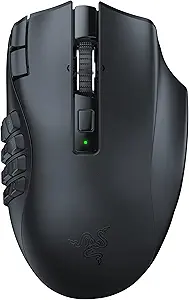 | Best for MMO Players | Buttons: 19 programmable | Sensor: Focus Pro 30K Optical | Battery Life: Up to 400 hours (Bluetooth), 250 hours (HyperSpeed) | VIEW LATEST PRICE | See Our Full Breakdown |
| Razer Orochi V2 Wireless Gaming Mouse |  | Best Compact Travel Pick | Weight: 60g (excluding battery) | DPI: 18,000 | Battery Life (Bluetooth): 950 hours | VIEW LATEST PRICE | See Our Full Breakdown |
| Wireless Gaming Mouse with Rechargeable Battery and Type-C Fast Charging |  | Best Budget Rechargeable Option | Connectivity: 2.4GHz wireless | DPI Levels: 800 / 1200 / 1600 | Battery Life: Over 21 days per charge | VIEW LATEST PRICE | See Our Full Breakdown |
| Redragon M612 Wireless RGB Optical Gaming Mouse |  | Best Value Multi-Button Pick | DPI Levels: 500 / 1000 / 2000 / 3000 / 8000 | Programmable Buttons: 12 | Connectivity: Bluetooth, 2.4GHz wireless, USB wired | VIEW LATEST PRICE | See Our Full Breakdown |
| Logitech G305 Lightspeed Wireless Gaming Mouse – Black |  | Best Budget Performance Pick | Sensor: HERO 12K optical | DPI: 200–12,000 | Wireless Technology: Lightspeed (1 ms report rate) | VIEW LATEST PRICE | See Our Full Breakdown |
| Redragon M913 Wireless RGB MMO Gaming Mouse |  | Best Budget MMO Button Layout | Connectivity: Wireless (2.4GHz) and Wired (USB-C) | Number of Buttons: 16 | Side Buttons: 12 | VIEW LATEST PRICE | See Our Full Breakdown |
| Logitech G703 Lightspeed Wireless Gaming Mouse |  | Best for Wireless Charging Addicts | Sensor: HERO 25K | Max DPI: 25,600 | IPS: 400+ | VIEW LATEST PRICE | See Our Full Breakdown |
| INPHIC A9 V2 Explorer Wireless Gaming Mouse |  | Best Quiet Work-and-Play Hybrid | Max DPI: 12,800 | Connection Options: Bluetooth, 2.4G wireless, USB-C wired | Weight: 102 g | VIEW LATEST PRICE | See Our Full Breakdown |
| Razer Basilisk V3 X HyperSpeed Wireless Gaming Mouse |  | Best Battery Life | Connectivity: Wireless (HyperSpeed and Bluetooth) | Battery Life: Up to 285 hours (HyperSpeed), 535 hours (Bluetooth) | Sensor: Razer 5G Advanced 18K Optical | VIEW LATEST PRICE | See Our Full Breakdown |
| Logitech G502 Lightspeed Wireless Gaming Mouse |  | Best Feature-Loaded All-Rounder | Wireless Technology: Lightspeed | Sensor: HERO 25K | Max DPI: 25,600 | VIEW LATEST PRICE | See Our Full Breakdown |
| Logitech G305 Lightspeed Wireless Gaming Mouse – White |  | Best Value Wireless Gaming Mouse | Sensor: HERO optical, 12,000 DPI | Wireless Technology: Lightspeed | Response Time: 1 ms | VIEW LATEST PRICE | See Our Full Breakdown |
| Redragon M810 PRO Wireless RGB Gaming Mouse 10000 DPI with Remapping Keys |  | Best Budget RGB Customization | Sensor: 10,000 DPI optical | DPI Levels: 5 | Polling Rate: 1000Hz | VIEW LATEST PRICE | See Our Full Breakdown |
| Logitech G305 Lightspeed Wireless Gaming Mouse – Blue |  | Best Portable Pick for Gaming on the Go | Sensor: HERO optical, 12,000 DPI | Wireless Technology: Lightspeed | Response Time: 1 ms | VIEW LATEST PRICE | See Our Full Breakdown |
| Razer Viper V3 HyperSpeed Wireless PC Gaming Mouse, 82g, Black |  | Best for Competitive FPS Play | Sensor: Focus Pro 30K Optical | Weight: 82g | Connectivity: HyperSpeed Wireless | VIEW LATEST PRICE | See Our Full Breakdown |
| wireless gaming mice | Battery Life | Sensor | Connectivity | Weight |
|---|---|---|---|---|
| Razer Naga V2 HyperSpeed Wirel | Up to 400 hours (Bluetooth), 250 hours (HyperSpeed) | Focus Pro 30K Optical | Razer HyperSpeed Wireless (2.4 GHz), Bluetooth | — |
| Razer Orochi V2 Wireless Gamin | — | — | Bluetooth and HyperSpeed Wireless | 60g (excluding battery) |
| Wireless Gaming Mouse with Rec | Over 21 days per charge | — | 2.4GHz wireless | — |
| Redragon M612 Wireless RGB Opt | — | — | Bluetooth, 2.4GHz wireless, USB wired | 3.84 ounces |
| Logitech G305 Lightspeed Wirel | Up to 250 hours on 1 AA; up to 9 months in Endurance mode | HERO 12K optical | — | 3.4 oz (99 grams) |
| Redragon M913 Wireless RGB MMO | 45 hours (backlit), 80 hours (eco mode) | — | Wireless (2.4GHz) and Wired (USB-C) | — |
| Logitech G703 Lightspeed Wirel | up to 35 hours | HERO 25K | — | 95 g |
| INPHIC A9 V2 Explorer Wireless | — | — | — | 102 g |
| Razer Basilisk V3 X HyperSpeed | Up to 285 hours (HyperSpeed), 535 hours (Bluetooth) | Razer 5G Advanced 18K Optical | Wireless (HyperSpeed and Bluetooth) | — |
| Logitech G502 Lightspeed Wirel | — | HERO 25K | — | — |
| Logitech G305 Lightspeed Wirel | Up to 250 hours (AA) | HERO optical, 12,000 DPI | — | — |
| Redragon M810 PRO Wireless RGB | Up to 45 hours | 10,000 DPI optical | — | — |
| Logitech G305 Lightspeed Wirel | Up to 9 months (AA) | HERO optical, 12,000 DPI | — | 3.4 oz |
| Razer Viper V3 HyperSpeed Wire | Up to 280 hours (AA) | Focus Pro 30K Optical | HyperSpeed Wireless | 82g |
More Details on Our Top Picks
Razer Naga V2 HyperSpeed Wireless MMO Gaming Mouse
Most wireless gaming mice compete on weight and speed, but the Naga V2 HyperSpeed plays a different game entirely: raw button count. With 19 programmable buttons on its signature 12-button thumb grid, this model is built for MMO and MOBA players who need entire rotations of abilities under one thumb. Compared with the Redragon M913, which offers a similar side-grid concept, the Naga V2 pairs its layout with a far more refined Focus Pro 30K sensor and Razer’s low-latency HyperSpeed connection, so it doesn’t feel like a compromise.
The tradeoff is obvious: this is a heavy, specialized tool. FPS players who loved the featherweight feel of the Viper V3 HyperSpeed will find the Naga bulky and its extra buttons pointless. Battery life is genuinely excellent — up to 400 hours on Bluetooth — but you’ll want the dongle positioned well to avoid interference in crowded wireless setups.
Pros:- 19 programmable buttons put full ability rotations under your thumb
- Focus Pro 30K sensor delivers precise tracking on nearly any surface
- Up to 400 hours of battery life on Bluetooth
- Dual connectivity with low-latency HyperSpeed wireless
Cons:- Bulky, button-heavy design is awkward for fast, low-sensitivity aiming
- Setup and full button remapping can be overwhelming for casual users
- Dongle placement matters — nearby wireless devices can cause interference
Best for: MMO and MOBA players who map dozens of abilities, spells, or macros to thumb buttons and want a premium wireless build
Not ideal for: FPS and competitive shooters players — the extra buttons and added bulk slow down flicks compared with lightweight models like the Viper V3
- Buttons:19 programmable
- Sensor:Focus Pro 30K Optical
- Battery Life:Up to 400 hours (Bluetooth), 250 hours (HyperSpeed)
- Connectivity:Razer HyperSpeed Wireless (2.4 GHz), Bluetooth
- Switches:Mechanical Mouse Switches Gen 2
- Color:Black
Our verdict“If your games live or die on ability bars rather than aim duels, this is the most complete wireless MMO mouse in the lineup.”
Razer Orochi V2 Wireless Gaming Mouse
Where the Naga V2 HyperSpeed goes big, the Orochi V2 goes small — and that’s exactly the point. At around 60 grams without the battery, this is the mouse for gamers who split time between a desktop and a laptop bag. Its battery numbers are the headline: up to 950 hours on Bluetooth, which means months between swaps and zero charging cables to carry. Compared with the Logitech G305, another popular travel option, the Orochi V2 is lighter, smaller, and more flexible — it accepts either a AA or AAA battery, letting you tune the weight to your preference.
The compromises are real, though. The 18K DPI sensor trails Razer’s newer 30K units, there’s no wired fallback when batteries die, and the compact shell cramps larger hands during long sessions. This pick makes the most sense for palm-averse travelers, not desktop marathoners.
Pros:- Up to 950 hours of Bluetooth battery life — months between changes
- Featherweight 60g build (excluding battery) for quick, easy movement
- Dual wireless modes with AA or AAA battery flexibility
- Switches rated for 60 million clicks
Cons:- No wired mode — a dead battery means downtime until you swap cells
- Battery weight shifts the balance depending on which size you install
- Compact shape can fatigue larger hands over extended play
Best for: Students, commuters, and laptop gamers who want a pocketable mouse with battery life measured in months
Not ideal for: Players with large hands or those who prefer a full-sized ergonomic shell for long desktop sessions
- Weight:60g (excluding battery)
- DPI:18,000
- Battery Life (Bluetooth):950 hours
- Battery Life (HyperSpeed):425 hours
- Connectivity:Bluetooth and HyperSpeed Wireless
- Battery Type:AA or AAA (user’s choice)
- Switch Durability:60 million clicks
Our verdict“The Orochi V2 is the clear choice when portability and battery endurance matter more than a full-sized grip.”
Wireless Gaming Mouse with Rechargeable Battery and Type-C Fast Charging
Most mice at this price ask you to buy batteries forever. This one breaks that pattern with a built-in rechargeable battery and Type-C fast charging — and because it charges while in use, you never lose playtime to a charging cycle. For buyers comparing it against the Redragon M612, which relies on replaceable cells, the difference is straightforward: this model trades peak DPI for convenience. Its adjustable DPI tops out at 1600, which is plenty for everyday gaming and productivity but far below the 8000 DPI ceiling of the Redragon or the 12,000 of the Logitech G305.
That low DPI cap is the real tradeoff — competitive players who sweep across multiple monitors will feel pinched. The side buttons also click audibly, a small but real annoyance for anyone wanting quieter hardware like the INPHIC A9 V2. Still, for casual gamers and students who want a plug-in-and-forget mouse, the value argument is strong.
Pros:- Rechargeable battery with over 21 days per charge — no battery purchases
- Type-C fast charging works while you keep playing
- Ergonomic, lightweight shape reduces fatigue in long sessions
- RGB lighting can be adjusted or switched off entirely
Cons:- DPI maxes out at 1600, far below similarly priced rivals
- Side buttons are noticeably clicky with no silent option
- Generic brand means less software support and weaker warranty backing
Best for: Budget-conscious casual gamers and students who want rechargeable convenience over high-end specs
Not ideal for: Competitive or high-sensitivity players — the 1600 DPI ceiling is too low for fast, wide-sweep aiming
- Connectivity:2.4GHz wireless
- DPI Levels:800 / 1200 / 1600
- Battery Life:Over 21 days per charge
- Charging:Type-C fast charging
- Buttons:6 customizable
- Lighting:RGB LED, adjustable or off
Our verdict“A sensible pick if you’d rather never buy batteries again than chase a high DPI number.”
Redragon M612 Wireless RGB Optical Gaming Mouse
The Redragon M612 occupies a smart middle ground: it delivers 12 programmable buttons and 8000 DPI at a price that undercuts everything from Razer and Logitech in this lineup. Against the Redragon M913, its sibling with even more buttons, the M612 is the lighter, simpler bet; against the Logitech G305, it offers triple-mode connectivity — Bluetooth, 2.4GHz wireless, and wired USB — where the G305 offers none of that flexibility. Its seven RGB backlight modes add desk flair that more austere competitors skip entirely.
But the savings show up in the details. The plastic shell feels less premium than a Basilisk V3 X HyperSpeed, the required battery adds recurring cost and weight, and compatibility is limited to Windows 10, which locks out Mac and Linux users. This model makes the most sense for PC gamers who want function-per-dollar, not refinement.
Pros:- 12 programmable buttons with macro remapping at a budget price
- 8000 DPI sensor with five adjustable levels
- Triple connectivity: Bluetooth, 2.4GHz wireless, and wired USB
- Seven RGB backlight modes for visual customization
Cons:- Windows 10-only compatibility excludes Mac and Linux users
- Plastic construction feels cheap next to premium rivals
- Depends on a battery that eventually needs replacing
Best for: PC gamers on a budget who want programmable macros, high DPI headroom, and RGB without paying premium-brand prices
Not ideal for: Mac, Linux, or console users — Windows 10-only support and a plastic build will disappoint anyone wanting cross-platform polish
- DPI Levels:500 / 1000 / 2000 / 3000 / 8000
- Programmable Buttons:12
- Connectivity:Bluetooth, 2.4GHz wireless, USB wired
- Backlit Modes:7 RGB modes
- Weight:3.84 ounces
- Compatibility:PC and tablet, Windows 10
- Range:10 meters
- Battery:1 Lithium Polymer (included)
Our verdict“Feature count per dollar is hard to beat here, as long as you game on Windows and can accept a less refined feel.”
Logitech G305 Lightspeed Wireless Gaming Mouse – Black
The Logitech G305 has earned its long-standing reputation by doing the basics exceptionally well: a proven HERO 12K sensor, a 1 ms report rate over Lightspeed wireless, and up to 250 hours on a single AA battery — or roughly nine months in Endurance mode. Compared with the budget Redragon M612, the G305 offers tighter, more consistent tracking and Logitech’s far better software ecosystem, though it gives up six extra buttons and RGB lighting. Against its own siblings, the G703 and G502 Lightspeed, it’s the lightest and cheapest way into Logitech’s wireless ecosystem.
The compromises are the flip side of its simplicity. Six programmable buttons is the floor for serious customization, there’s no wired mode when the AA dies, and the shape is a basic ambidextrous-style shell without the sculpted comfort of pricier models. For competitive-minded players who just want reliable aim at a low price, none of that matters much.
Pros:- HERO 12K sensor with 200–12,000 DPI range for precise, consistent tracking
- 1 ms Lightspeed report rate rivals wired responsiveness
- Up to 250 hours per AA battery, or 9 months in Endurance mode
- Built-in nano receiver storage makes it genuinely travel-friendly
Cons:- Only 6 programmable buttons — minimal for MMO or macro-heavy play
- No wired mode as a fallback when the battery dies
- Plain, symmetrical shape lacks the sculpted comfort of premium models
Best for: Competitive and semi-serious gamers who want proven low-latency performance and great battery life at a mid-budget price
Not ideal for: Players who want maximum programmability or a sculpted, ergonomic shell — six buttons and a basic shape will feel limiting
- Sensor:HERO 12K optical
- DPI:200–12,000
- Wireless Technology:Lightspeed (1 ms report rate)
- Battery Life:Up to 250 hours on 1 AA; up to 9 months in Endurance mode
- Weight:3.4 oz (99 grams)
- Buttons:6 programmable
- Compatibility:PC
Our verdict“For gamers who value trustworthy sensor performance over features, the G305 remains the safest budget pick in this roundup.”
Redragon M913 Wireless RGB MMO Gaming Mouse
Twelve side buttons are the entire story here, and no other mouse at this price comes close to that count. Compared with the Razer Naga V2 HyperSpeed, the M913 delivers a similar MMO thumb-grid layout for a fraction of the cost, though it gives up the Naga’s cleaner software and refinement. The dual wireless and wired modes mean you can keep playing while charging, a flexibility the pricier Razer Basilisk V3 X lacks. The 16,000 DPI ceiling is more than enough for any genre. The tradeoff is weight — this is a heavy mouse, and buyers coming from something like the Razer Viper V3 will feel it immediately. The remapping software also takes patience to learn.
Pros:- 12 side buttons for MMO macros at a budget price
- Dual wireless and USB-C wired modes let you game while charging
- Up to 80 hours of battery in eco mode
- 16,000 DPI with five adjustable levels
Cons:- Heavier than most competitors due to the button array
- Software for full button remapping is unintuitive
Best for: MMO and MOBA players on a budget who need a full 12-button thumb grid without paying Razer Naga prices
Not ideal for: FPS players or anyone who values a lightweight, fast-swipe feel — the button-heavy build makes it heavy and sluggish
- Connectivity:Wireless (2.4GHz) and Wired (USB-C)
- Number of Buttons:16
- Side Buttons:12
- Max DPI:16,000
- DPI Levels:1000, 2000, 4000, 8000, 16000
- Lighting:16.8 million colors
- Battery Life:45 hours (backlit), 80 hours (eco mode)
Our verdict“Buy this if you want maximum macro buttons per dollar; skip it if you mainly play fast-paced shooters.”
Logitech G703 Lightspeed Wireless Gaming Mouse
The G703’s defining feature is PowerPlay compatibility — pair it with Logitech’s charging mousepad and you never plug in again, something only the G502 Lightspeed in this lineup can match. Where the G502 is a button-loaded, heavier all-rounder, the G703 keeps things simple at 95g with six programmable buttons and a softer, more symmetrical-ish shape that suits palm and claw grips. The HERO 25K sensor is the same flagship tracker Logitech uses across its premium range, so accuracy is never a question. The catch is value: if you don’t buy the separately sold PowerPlay pad, you’re paying a premium for charging hardware you’ll never use, and rivals like the Razer Basilisk V3 X beat it badly on battery life.
Pros:- HERO 25K sensor with flawless tracking
- PowerPlay wireless charging support for infinite battery
- Lightweight 95g design comfortable for long sessions
- LIGHTSYNC RGB and six programmable buttons
Cons:- PowerPlay charging system sold separately at a high cost
- 35-hour battery life trails cheaper competitors by a wide margin
Best for: Players already invested in — or planning to buy — the Logitech PowerPlay ecosystem who want a clean six-button mouse
Not ideal for: Budget-conscious buyers — without the separately sold charging pad, the price is hard to justify over a Razer Basilisk V3 X
- Sensor:HERO 25K
- Max DPI:25,600
- IPS:400+
- Weight:95 g
- Battery Life:up to 35 hours
- Lighting:LIGHTSYNC RGB
- Buttons:6 programmable
- Wireless Charging:Supported with POWERPLAY (sold separately)
Our verdict“This pick makes the most sense for PowerPlay owners; everyone else should compare it against the Basilisk V3 X before buying.”
INPHIC A9 V2 Explorer Wireless Gaming Mouse
This option stands out for silent click technology, which no other mouse in this roundup offers — it’s the pick for shared offices, late-night gaming, or anyone whose clicking annoys the household. The tri-mode connectivity (Bluetooth, 2.4G, USB-C wired) also makes it the most flexible mouse here for multi-device use; you can pair it with a work laptop over Bluetooth and a gaming PC over 2.4G. Compared with dedicated gaming mice like the Logitech G703, the 12,800 DPI sensor is respectable but not flagship-tier, and there’s no RGB or macro support — this is a productivity mouse with gaming chops, not the reverse. At 102g it’s also on the heavier side for competitive play.
Pros:- Silent clicks ideal for offices and shared spaces
- Three connection modes for multi-device setups
- Works across Windows, macOS, Android, and iOS
- Rechargeable battery with fast USB-C charging
Cons:- No RGB lighting or macro customization
- Driver download required for advanced settings on Windows
- Sensor and weight fall short of dedicated gaming mice
Best for: Students and hybrid workers who want one quiet mouse that switches between office laptop and casual gaming PC
Not ideal for: Enthusiast gamers who want RGB, macro programming, or a top-tier sensor — this mouse prioritizes quiet versatility
- Max DPI:12,800
- Connection Options:Bluetooth, 2.4G wireless, USB-C wired
- Weight:102 g
- Click Noise:Silent click technology
- Battery:High-capacity rechargeable
- Compatibility:Windows, macOS, Android, iOS
Our verdict“Choose this if quiet operation and cross-device flexibility matter more than raw gaming performance.”
Razer Basilisk V3 X HyperSpeed Wireless Gaming Mouse
Up to 285 hours on HyperSpeed — and 535 hours over Bluetooth — is a figure that embarrasses every other wireless mouse in this guide. The Logitech G703 manages 35 hours; the Redragon M913 tops out at 80 in eco mode. That endurance comes from Razer’s efficient sensor and the absence of power-hungry extras, and it means weeks of daily play between charges. The ergonomic right-handed shape with nine customizable controls also hits a sweet spot between the button-heavy M913 and the minimalist G703. The real tradeoff is the lack of a wired mode: when the battery finally dies, you’re stuck waiting for a recharge, unlike the M913 which lets you plug in and keep going.
Pros:- Class-leading battery life of up to 285 (HyperSpeed) or 535 hours (Bluetooth)
- Ergonomic right-handed shape for extended comfort
- Nine customizable buttons with Gen-2 mechanical switches
- Chroma RGB with 16.8 million colors
Cons:- No wired mode to use while recharging
- Real-world battery life drops with RGB lighting enabled
Best for: Gamers who hate charging cables and want a comfortable, long-lasting mouse for marathon sessions
Not ideal for: Players who want a wired fallback during low battery — there’s no USB pass-through mode here
- Connectivity:Wireless (HyperSpeed and Bluetooth)
- Battery Life:Up to 285 hours (HyperSpeed), 535 hours (Bluetooth)
- Sensor:Razer 5G Advanced 18K Optical
- Switches:Razer Mechanical Gen-2
- Lighting:Razer Chroma RGB
- Controls:9 customizable buttons
Our verdict“If battery anxiety drives your purchases, this is the endurance champion of the roundup — just accept the no-wired-mode tradeoff.”
Logitech G502 Lightspeed Wireless Gaming Mouse
The G502 Lightspeed is the most configurable mouse in this batch — eleven programmable buttons, an adjustable hyper-fast scroll wheel, and onboard profiles make it a tool for both MMO players and productivity power users. Think of it as the G703’s bigger sibling: same HERO 25K sensor and PowerPlay compatibility, but with five extra buttons and the signature infinite scroll wheel that’s unbeatable for long documents. Against the Redragon M913, it offers far better software and build quality, though the M913 still wins on raw side-button count and price. The drawbacks are predictable: it’s expensive, and the genuinely transformative PowerPlay charging system costs extra on top. If you don’t need the button count, the lighter G703 is the smarter buy.
Pros:- 11 customizable buttons plus a hyper-fast scroll wheel
- HERO 25K sensor with 25,600 DPI
- PowerPlay wireless charging compatibility
- Excellent Logitech G Hub software and profiles
Cons:- One of the pricier picks in the roundup
- PowerPlay charging pad sold separately
- Heavier and busier than simpler mice like the G703
Best for: Power users and MMO players who want maximum programmability plus flagship sensor performance
Not ideal for: Minimalists and budget buyers — the extra buttons add cost and weight that lighter users won’t exploit
- Wireless Technology:Lightspeed
- Sensor:HERO 25K
- Max DPI:25,600
- Buttons:11 customizable
- Scroll Wheel:Hyper-fast
- Charging System:PowerPlay compatible (sold separately)
Our verdict“Buy this if eleven buttons and the scroll wheel fit your workflow; choose the G703 instead if six buttons are enough.”
Logitech G305 Lightspeed Wireless Gaming Mouse – White
When the goal is reliable wireless performance without overspending, the Logitech G305 Lightspeed in white is the pick that makes the most sense. Its HERO sensor at 12,000 DPI and 1 ms Lightspeed connection deliver tracking that feels indistinguishable from far pricier options — including the Razer Viper V3 HyperSpeed for everyday play. The 250-hour battery life means you can game for months on a single AA cell.
The tradeoffs are structural: no RGB, no rechargeable battery, and no wired fallback. Compared with the Redragon M810 PRO, you give up lighting and extra programmable buttons, but you gain cleaner software, a lighter feel, and Logitech’s proven sensor consistency. This model suits buyers who prioritize performance-per-dollar over flair.
Pros:- Proven HERO sensor with accurate 12,000 DPI tracking
- 1 ms Lightspeed wireless latency rivals wired mice
- Up to 250 hours of battery life on one AA
- Trusted build quality at an entry-level price
Cons:- AA battery replacement instead of built-in rechargeable cell
- No RGB lighting or extensive button customization
Best for: Budget-conscious gamers who want proven low-latency wireless performance and don’t care about RGB lighting
Not ideal for: Players who want rechargeable batteries and visual customization — the AA-only power and zero lighting will feel dated
- Sensor:HERO optical, 12,000 DPI
- Wireless Technology:Lightspeed
- Response Time:1 ms
- Battery Life:Up to 250 hours (AA)
- Design:Lightweight, ergonomic
- Color:White
Our verdict“The smartest choice for anyone who wants competitive-grade wireless performance at a budget price and can live without rechargeable power or RGB.”
Redragon M810 PRO Wireless RGB Gaming Mouse 10000 DPI with Remapping Keys
For buyers who want flash and functionality together on a tight budget, the Redragon M810 PRO stands out. With 8 programmable buttons, 5 DPI levels up to 10,000, and customizable RGB, it offers a level of tailoring the Logitech G305 simply can’t match at any colorway. MMO-lite players and productivity users who remap keys will appreciate the flexibility.
The compromises are real, though. Its 45-hour battery life is the shortest in this group — roughly a fifth of the G305’s endurance — and RGB lighting drains it faster still. Full customization requires Redragon’s software, which is less polished than Logitech G HUB. Compared with the Redragon M913, it’s lighter on features but easier on the wallet. This option suits style-minded gamers more than purists chasing maximum battery.
Pros:- 8 programmable buttons for macros and remapping
- Customizable RGB lighting at a budget price
- 10,000 DPI sensor with 5 adjustable levels
- Low-latency 2.4GHz wireless with 1000Hz polling
Cons:- Short battery life that shrinks further with RGB enabled
- Software needed for full customization is less refined than rivals
Best for: Value-focused gamers and productivity users who want programmable buttons and RGB lighting without paying premium prices
Not ideal for: Marathon gamers who hate charging — 45 hours of battery life demands frequent recharges compared to Logitech alternatives
- Sensor:10,000 DPI optical
- DPI Levels:5
- Polling Rate:1000Hz
- Wireless Technology:2.4GHz
- Programmable Buttons:8
- Battery Life:Up to 45 hours
- Lighting:Customizable RGB
Our verdict“The best cheap way to get programmable buttons and RGB together, as long as frequent recharging doesn’t bother you.”
Logitech G305 Lightspeed Wireless Gaming Mouse – Blue
The G305 Lightspeed in blue earns its spot as the travel-friendly option. At 3.4 oz with a compact shell, it slips into a laptop bag more easily than the larger Razer Basilisk V3 X HyperSpeed, and its up-to-9-month battery rating means you can leave the charger at home entirely. The HERO sensor and 1 ms Lightspeed link mean hotel-room matches feel just as responsive as at your desk.
What you sacrifice matches the white G305: no rechargeable cell, no RGB, and a six-button layout that MMO players will find sparse next to the Razer Naga V2 HyperSpeed. It’s also the same mouse internally as its siblings — you’re choosing it for the color and portability, not new features. For students and frequent travelers, that tradeoff lands well.
Pros:- Compact, lightweight 3.4 oz body built for portability
- Up to 9 months of battery life on a single AA
- HERO sensor with 12,000 DPI precision
- 1 ms Lightspeed wireless for lag-free play anywhere
Cons:- AA battery dependency with no rechargeable option
- Minimal customization compared to feature-rich wired rivals
Best for: Students, laptop gamers, and frequent travelers who need a compact mouse with months-long battery life
Not ideal for: Buyers who want a rechargeable battery or extensive button layouts — the AA power and 6-button design limit both
- Sensor:HERO optical, 12,000 DPI
- Wireless Technology:Lightspeed
- Response Time:1 ms
- Battery Life:Up to 9 months (AA)
- Weight:3.4 oz
- Design:Lightweight, compact
- Color:Blue
Our verdict“The ideal grab-and-go wireless mouse for gamers who travel light and value battery endurance over extras.”
Razer Viper V3 HyperSpeed Wireless PC Gaming Mouse, 82g, Black
When frame-perfect flicks are the priority, the Razer Viper V3 HyperSpeed is the strongest performer in this group. Its Focus Pro 30K sensor outclasses the 12,000 DPI units in both G305 colorways, and the 82g symmetrical shell is built for the fast, low-sensitivity swipes that FPS players demand. Gen-2 mechanical switches rated for 60 million clicks add long-term click reliability the Redragon options don’t guarantee.
The drawback is surprising for the price: it runs on a replaceable AA battery with no wired mode at all — unlike the Logitech G502 Lightspeed, which supports charging while playing. And while 280 hours of endurance is excellent, players used to USB-C rechargeable mice like the Orochi V2’s rivals may find swapping cells annoying. This model is better suited to ranked grinders than casual RGB enthusiasts.
Pros:- Focus Pro 30K sensor with best-in-group tracking precision
- 82g lightweight body built for fast aiming
- Up to 280 hours of battery life
- Gen-2 mechanical switches rated for 60 million clicks
Cons:- AA battery replacement with no wired charging option
- No RGB or extra programmable buttons for the price
Best for: Competitive FPS players who prioritize sensor precision, low weight, and low latency over convenience features
Not ideal for: Gamers who want a rechargeable battery or wired fallback — AA-only power with no USB mode feels limiting at this price
- Sensor:Focus Pro 30K Optical
- Weight:82g
- Connectivity:HyperSpeed Wireless
- Battery Life:Up to 280 hours (AA)
- Switches:Mechanical Gen-2, 60 million clicks
- DPI Stages:5
- Color:Black
Our verdict“The top pick here for serious FPS competitors who value sensor and weight above rechargeable convenience.”

How We Picked
I evaluated these 14 wireless gaming mice against the criteria that actually affect gameplay: connection stability and latency, sensor accuracy (measured in DPI ceiling and tracking consistency), battery life and charging method, weight and ergonomics across grip styles, and software quality for button remapping and onboard profiles. I also weighed price against durability signals like switch type, build materials, and warranty reputation, because a cheap mouse that double-clicks within a year is not a bargain.
The ranking logic is role-based rather than purely price-based. A $30 Redragon earns its spot by outperforming similarly priced generics, while a $150 Logitech G502 Lightspeed earns its rank through features no cheaper option replicates. Products that duplicate each other — like the three G305 colorways — are grouped so readers understand they are choosing a color, not a different mouse. Where a mouse has a clear weakness, such as excessive weight or bloated software, that tradeoff is stated plainly so the ranking reflects real buyer outcomes, not spec sheets.
Factors to Consider When Choosing Wireless Gaming Mice
Before picking a specific model, it helps to understand what actually separates a good wireless gaming mouse from a disappointing one. These are the factors that shaped my rankings, and the ones most buyers get wrong.Latency Matters More Than DPI
The single biggest mistake buyers make is chasing DPI numbers. A 26,000 DPI sensor sounds impressive, but almost no one plays above 3,200 DPI, and a generic 8,000 DPI mouse with a weak connection will feel worse than a 12,000 DPI mouse with a strong one. What matters is connection stability and polling rate: Logitech’s Lightspeed, Razer’s HyperSpeed, and similar proprietary 2.4GHz protocols keep latency under a few milliseconds, which competitive players can feel. Bluetooth-only mice should be avoided for gaming entirely because of intermittent stutter. If a listing doesn’t specify a dedicated USB receiver, treat that as a warning sign rather than a minor omission.
Battery Life and Charging Habits
Wireless mice range from models needing a charge every few days to others lasting hundreds of hours, and the difference shapes your daily experience more than most specs. The Razer Naga V2 HyperSpeed’s 400-hour rating means monthly charging, while RGB-heavy budget mice can drain a battery mid-session if lighting is left on. Buyers using AA or AAA batteries (like the G305 and Orochi V2) trade a slightly heavier mouse for the ability to swap cells in seconds and never wait on a charge. If you hate cables entirely, prioritize models with long rated battery life with lighting disabled, because manufacturer numbers almost always assume RGB is off. Rechargeable models with Type-C fast charging are convenient, but only if the battery actually holds capacity over a year of cycles.
Weight, Grip Style, and Hand Size
Weight is the spec competitive players care about most, and it’s where budget wireless mice lose ground. Anything under 85 grams suits fast flicking and low-sensitivity aiming, while 100g+ MMO mice like the Naga and Redragon M913 sacrifice agility for their button grids. Match the mouse to your grip style: claw and fingertip grippers do better with smaller shells like the Orochi V2 or Viper V3, while palm-grip players with larger hands will find the G502 Lightspeed and G703 far more comfortable over long sessions. Hand size matters too — a compact travel-friendly mouse can cause cramping for anyone with big hands. When in doubt, err slightly lighter, because weight fatigue accumulates over hours, not minutes.
Software Ecosystem and Button Remapping
The software behind the mouse determines whether extra buttons are an asset or a frustration. Logitech G HUB and Razer Synapse are mature, with per-game profiles, onboard memory, and reliable macro support — this is part of what you pay for with brand-name mice. Budget brands like Redragon and generic models offer remapping, but the software tends to be clunkier, less frequently updated, and sometimes requires re-application after Windows updates. If you play MMOs or productivity-adjacent games, count how many buttons you’ll realistically map and check that the software supports the functions you need. Silent-click office-style mice like the INPHIC A9 V2 sit at the bottom of this spectrum: fine for casual use, limiting for anything macro-heavy.
When to Pay More — and When Not To
Premium pricing buys three things: lighter construction without fragility, better switches rated for tens of millions of clicks, and more refined sensors with consistent tracking at high speeds. If you play ranked shooters daily, those upgrades are worth real money. If you game a few hours a week, a sub-$50 mouse like the G305 delivers 90% of the experience for a third of the price, and spending more buys diminishing returns. The mid-range is where value peaks in 2026 — models like the Viper V3 and Basilisk V3 X HyperSpeed carry flagship-grade internals without flagship pricing. The mistake to avoid is buying a cheap MMO mouse with 12 buttons you’ll never use instead of a quality simple mouse you’ll love.
Watch for Duplicate Models and Marketing Padding
This roundup alone contains three identical Logitech G305 mice in different colors, and many store listings repeat the same product under different names. Before buying, check the sensor model and connectivity rather than the product name, because colorway variants are priced differently for no functional reason. Marketing padding is rampant too: inflated DPI ceilings, “gaming” branding on office-grade hardware, and battery claims measured with lighting disabled. Generic listings without a brand name — like unbranded rechargeable models — make comparison shopping nearly impossible since the same shell ships under multiple names with different internals. Sticking to recognizable product lines protects you from these traps.
Frequently Asked Questions
Is a wireless gaming mouse actually as fast as a wired one now?
Yes, as long as you use the bundled 2.4GHz USB receiver rather than Bluetooth. Proprietary protocols like Logitech Lightspeed and Razer HyperSpeed keep latency within a couple of milliseconds of a wired connection, which is below what human reflexes can detect. The Viper V3 HyperSpeed and G502 Lightspeed in this lineup are both used by competitive players without any compromise. Where wireless still trails wired is convenience, not speed: you need to manage charging or battery swaps. Bluetooth mode, by contrast, is fine for desktop work but introduces enough stutter to hurt fast-paced gameplay, so treat it as a backup rather than your primary connection.
Should I buy the Logitech G305 in Black, White, or Blue — is there any difference?
Functionally, none at all. All three G305 colorways share the same HERO sensor, Lightspeed receiver, AA battery power, and six programmable buttons, so pick whichever color matches your setup or is cheapest that day. This matters because retailers sometimes price identical color variants differently, and shoppers accidentally pay a premium for paint. The one real decision with the G305 is whether its small, lightweight shell fits your hand — it runs on a single AA battery and suits claw and fingertip grips best. Larger-handed palm-grip players may prefer the G703 or G502 Lightspeed instead, which offer bigger shells at higher prices.
Are budget Redragon wireless mice good enough for serious gaming?
They’re good enough for most players, but with clear caveats. The Redragon M612, M913, and M810 PRO deliver working wireless connections, solid DPI ranges, and useful programmable buttons at prices branded mice can’t touch, which makes them excellent starter or secondary mice. The tradeoffs are weight — most Redragon models run 100g or heavier, which slows fast aiming — plus click switches that feel less crisp and software that’s noticeably rougher than Logitech G HUB or Razer Synapse. If you play MMOs or RPGs casually, those weaknesses barely matter. If you play competitive shooters where every gram and millisecond counts, spending more on the Viper V3 HyperSpeed will be immediately noticeable.
Is an MMO mouse with lots of side buttons worth it if I mostly play shooters?
Generally no, and it can actively hurt your aim. MMO mice like the Naga V2 HyperSpeed and Redragon M913 carry 12-button thumb grids that add substantial weight and force your thumb into a flat, less controlled position — great for hotbars in World of Warcraft, awkward for flick shots in Valorant. Shooters benefit from lightweight, simple shells like the Viper V3 or G305, where speed and grip comfort matter more than button count. The exception is hybrid players: if you split time between MMOs and shooters, a middle-ground option like the Basilisk V3 X HyperSpeed or G502 Lightspeed offers a handful of extra buttons without the full thumb grid. Buy for the game you play most, not the one you might play someday.
Do I need to replace batteries, or should I get a rechargeable wireless mouse?
Both approaches work well; the right one depends on your habits. Battery-powered mice like the G305 and Orochi V2 let you swap a dead AA in ten seconds and never degrade, but they add a few grams of weight and require keeping spares around. Built-in rechargeable batteries, as in the Viper V3 and G502 Lightspeed, keep weight lower and charge over Type-C, but capacity slowly fades over a few years and you’ll occasionally need to play while plugged in. Manufacturer battery ratings are usually measured with RGB lighting off, so expect roughly half the advertised life if you keep the lights on. Heavy daily gamers tend to prefer rechargeable convenience; occasional players get better longevity from swappable batteries.
Conclusion
The right wireless gaming mouse depends less on price and more on what you play and how you grip. For most readers, the Razer Viper V3 HyperSpeed is the best overall pick — it’s light, fast, comfortable across grip styles, and priced below flagship competitors. Best value goes to the Logitech G305 Lightspeed in any colorway, which remains the smartest sub-$50 purchase in the category and doubles as my recommendation for beginners who want proven wireless performance without a big commitment.
If budget isn’t a constraint, the Logitech G502 Lightspeed is the premium pick for palm-grip players who want buttons, weights, and a refined sensor in one package. For specific needs: MMO players should choose the Razer Naga V2 HyperSpeed for its 400-hour battery and 12-button grid, or the Redragon M913 for the same layout at a budget price; compact and travel-focused players get the Razer Orochi V2; and casual or quiet-environment gamers can save money with the INPHIC A9 V2’s silent clicks. Whatever you choose, prioritize a dedicated 2.4GHz receiver and a weight that suits your grip — everything else is negotiable.
Fall yard work Picks
leaf blowers
As an affiliate, we earn on qualifying purchases.