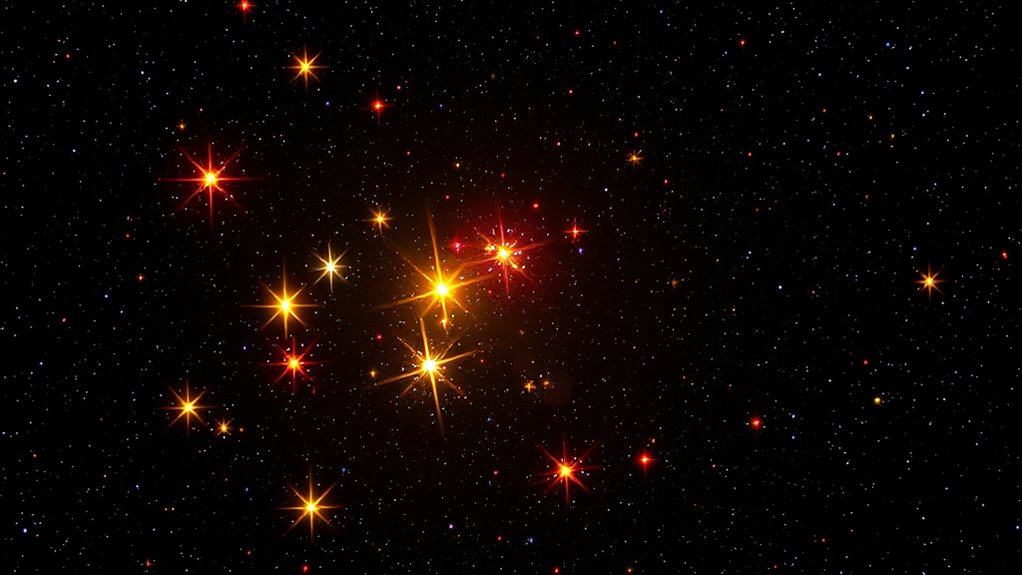
Star colors and spectral classes show you how stars vary in temperature, composition, and age. Cooler stars appear red or orange, while hotter ones glow blue or white, reflecting their surface temperatures. Spectral classes break down stars into categories like O, B, A, F, G, K, and M, based on their spectral lines, which reveal details about their makeup. Keep exploring, and you’ll discover more about how scientists decode these stellar clues to understand the universe better.
Key Takeaways
- Star colors indicate temperature: red/orange for cooler stars, blue/white for hotter stars.
- Spectral classes (O, B, A, F, G, K, M) categorize stars from hottest to coolest based on their spectra.
- Spectral analysis identifies absorption lines, revealing a star’s chemical composition and physical properties.
- Variations within spectral classes reflect differences in temperature and atmospheric composition among stars.
- Understanding star colors and spectral classes links observable features to stellar physics and evolution.
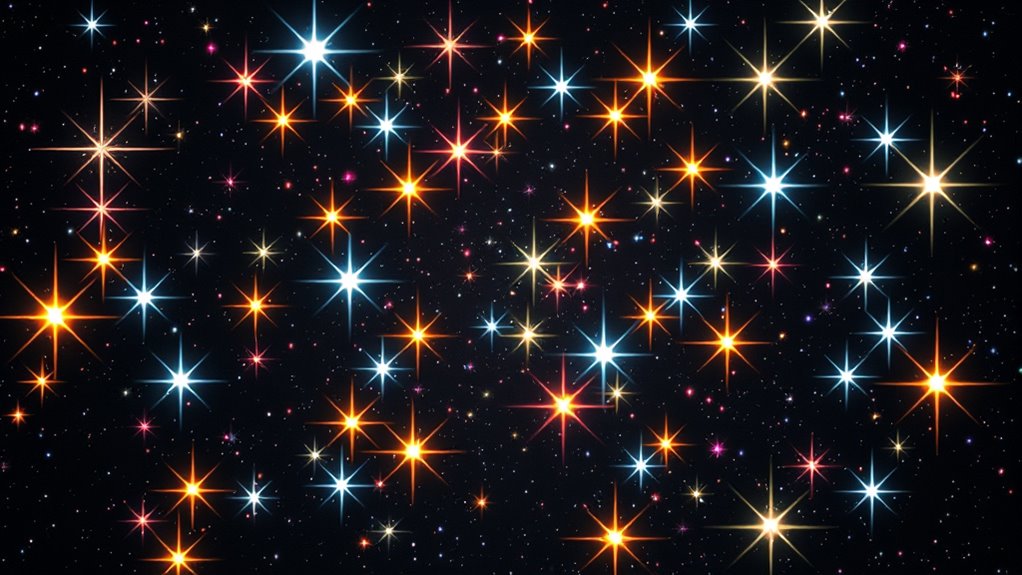
Stars display a stunning range of colors, from cool reds to blazing blues, which reveal their temperatures and compositions. This vibrant spectrum isn’t just for aesthetic appeal; it’s a key indicator of their physical properties. When you observe a star’s color, you’re essentially seeing a direct reflection of its stellar temperature variations. Cooler stars, often appearing red or orange, emit light at longer wavelengths, while hotter stars glow with blue or white hues, indicating higher surface temperatures. By understanding these color differences, astronomers can quickly gauge a star’s temperature without physically touching it.
To categorize stars based on their colors, scientists use spectral classification methods. These techniques analyze the star’s light spectrum, breaking it down into its component wavelengths. When light passes through a star’s atmosphere, certain wavelengths are absorbed by elements present there, creating dark lines known as absorption lines. These lines serve as fingerprints for specific elements, allowing you to determine what the star is made of and how hot it is. The spectral classification system groups stars into classes—O, B, A, F, G, K, and M—ranging from the hottest to the coolest. O-type stars shine brightly with blue hues, signaling extremely high stellar temperature variations, while M-type stars are cooler and redder. Each class has characteristic spectral lines that make identification straightforward once you analyze the spectrum.
Using spectral classification methods, you can also uncover subtle differences within these classes. For example, two stars might both be classified as G-type, but slight variations in their spectral lines indicate different surface temperatures and compositions. This system allows astronomers to create a detailed stellar temperature map across the galaxy. When you examine a star’s spectrum, you’re not just seeing a pretty light display; you’re deciphering a star’s physical characteristics, including its temperature, chemical makeup, and even its evolutionary stage. The spectral classification acts as a universal language, enabling scientists worldwide to communicate about stars with precision.
In a nutshell, understanding star colors and spectral classes empowers you to appreciate the complex physics governing our universe. The interplay of stellar temperature variations and spectral classification methods provides a window into the life cycles of stars and the diverse conditions that exist across the cosmos. Whether you’re gazing at a red dwarf or a luminous blue giant, you’re witnessing the outcome of processes that can be deciphered through the science of spectra. This knowledge transforms a simple stargazing experience into a journey of discovery about the universe’s fundamental nature.

Telescope,Telescope for Adults High Powered, 90mm Aperture 900mm Professional Refractor Telescopes for Kids & Beginners, Magnification 450X,for Planet Observation with Stainless Tripod & Phone Adapter
Telescope for Adults High Powered: Love exploring the night sky? HETEKAN telescope for adults, kids, and beginners wanting…
As an affiliate, we earn on qualifying purchases.
As an affiliate, we earn on qualifying purchases.
Frequently Asked Questions
How Do Star Colors Influence Their Lifespan?
You can see that star colors influence their lifespan through stellar temperature and color correlation. Hot, blue stars have higher stellar temperatures and burn fuel faster, leading to shorter lifespans. Conversely, cooler, red stars have lower temperatures, burn fuel slowly, and live longer. So, the color of a star directly impacts how quickly it consumes its fuel, determining its overall lifespan based on its stellar temperature and resulting color.
Can Stars Change Spectral Classes Over Time?
Ever wondered if a star can change its spectral class? Yes, during stellar evolution, stars do shift spectral classifications as their internal processes evolve. For example, a star may start as a main sequence star and become a giant or supergiant, altering its spectral type. These changes reflect shifts in temperature and composition, illustrating how stellar evolution drives stars to progress between spectral classes over their lifespans.
What Causes Unusual Star Colors Beyond Typical Classifications?
Unusual star colors often result from stellar wind and magnetic activity. When a star has strong stellar winds, they can create surrounding dust or gas that scatters light differently, altering its apparent color. Magnetic activity, like star spots or flares, can also influence the star’s surface temperature, causing unexpected hues. These factors combine to produce colors beyond the typical classifications, giving stars a more diverse and dynamic appearance.
Are There Any Stars With Spectral Classes That Are Not Visible?
Did you know that nearly 10% of stars have spectral class anomalies that make their colors invisible to the naked eye? Some stars, like neutron stars, emit primarily in radio or X-ray wavelengths, making their spectral classes undetectable visually. These stars don’t show typical color variations because their light isn’t in the visible spectrum. Instead, astronomers rely on specialized instruments to study their properties beyond what we see.
How Do Star Colors Relate to Their Planetary Systems?
You can see star colors hint at their compositions and temperatures, which influence star formation and planetary habitability. Blue stars are hot and young, often linked to active star-forming regions, while red stars are cooler and longer-lasting, making their planets more stable for life. Your understanding of star colors helps you appreciate how these factors affect the potential for planets to support life and the evolution of planetary systems.

National Geographic Backyard Guide to the Night Sky, 2nd Edition
As an affiliate, we earn on qualifying purchases.
As an affiliate, we earn on qualifying purchases.
Conclusion
Now that you know how star colors reveal their spectral classes, you see there’s more than meets the eye in the night sky. Each hue tells a story about a star’s temperature and life stage, like pieces of a puzzle coming together. Remember, understanding these cosmic clues can open your eyes to the universe’s secrets—truly, you’re seeing the stars in a whole new light. So, keep exploring; the sky’s the limit!

Ready-to-Decorate All About Me Star Student Posters – 24 Posters
Enough for Everyone: These Star Student Posters come as a pack of 24, making this an activity the…
As an affiliate, we earn on qualifying purchases.
As an affiliate, we earn on qualifying purchases.
spectral analysis tools for astronomy
As an affiliate, we earn on qualifying purchases.
As an affiliate, we earn on qualifying purchases.