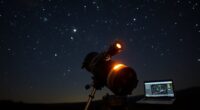
Exploring the night sky with star charts makes stargazing easier and more enjoyable. By using charts or apps, you can identify constellations and locate planets based on your specific location and time. These tools help you recognize patterns and develop a mental map of the sky, turning it from overwhelming into manageable. Keep exploring, and you’ll discover how star charts can transform your sky-watching experience into an educational adventure.
Key Takeaways
- Star charts help identify constellations and celestial objects, improving orientation in the night sky.
- Using apps that adapt to your location and time enhances the accuracy of star navigation.
- Recognizing constellation patterns creates a mental map, simplifying navigation across different sky regions.
- Augmented reality features in star chart apps overlay labels, aiding quick identification of stars and planets.
- Understanding sky layouts through star charts makes exploring the night sky more engaging and less confusing.

Have you ever looked up at the night sky and wondered how to navigate its vastness? It’s a common feeling, especially when you’re trying to identify stars or find specific celestial objects. Luckily, there are tools like constellations mapping and star chart apps that make exploring the sky easier and more accessible. These resources can turn an overwhelming sea of stars into a manageable map, guiding you through the night with confidence.
Using constellations mapping is a great way to familiarize yourself with the sky’s layout. Constellations act as landmarks, helping you orient yourself and locate other celestial objects. When you learn to recognize patterns like Orion’s belt or the Big Dipper, you gain a mental map of the sky that you can carry with you anywhere. Many star chart apps incorporate detailed constellations mapping, overlaying their outlines directly onto your phone’s display. With a quick glance, you can see which stars are visible in your location and time of night, making it easier to identify them in real life.
Constellations act as landmarks, helping you recognize patterns and locate celestial objects in the night sky.
Star chart apps are particularly useful because they adapt to your specific location and time, providing real-time, accurate maps of the night sky. Unlike traditional paper star charts, these apps update dynamically as you move or as the night progresses. They often include features like augmented reality, allowing you to point your device at the sky and see labels for stars, planets, or constellations overlaid on your screen. This interactive approach simplifies navigation and helps you learn the sky’s layout more intuitively. Plus, many of these apps offer additional tools, such as notifications for upcoming celestial events or detailed information about the objects you’re viewing.
Getting started with star chart apps is straightforward. Once you download a reputable one, you’ll typically set your location and date, and the app will generate a customized star map. As you look up at the sky, your app can show you which stars or planets are in view, guiding your gaze from one point to another. Over time, you’ll develop a better understanding of how constellations are arranged, and the sky will become less of a mystery. These tools turn stargazing from a confusing experience into an engaging, educational adventure.
In essence, constellations mapping and star chart apps are your keys to *unveiling* the secrets of the night sky. Whether you’re a beginner or an experienced skywatcher, they help you navigate the darkness with clarity and confidence. With just a few taps, you can identify stars, planets, and constellations, making every night under the stars a chance to explore the universe around you.
Additionally, understanding the positions of celestial objects can deepen your appreciation of astronomical phenomena and enhance your navigation skills.
Frequently Asked Questions
How Do I Choose the Right Star Chart for My Location?
To select the right star chart for your location, consider star chart accuracy and the specific area of the sky you want to observe. Look for charts tailored to your latitude and season, which provide precise depictions of visible constellations. When choosing star charts, select those labeled for your region or with adjustable features to guarantee you can easily navigate the night sky, making your stargazing experience more enjoyable and accurate.
Can Star Charts Be Used During Different Seasons Effectively?
Think of star charts as your celestial compass, guiding you through seasonal constellation visibility. Yes, they can be used effectively year-round. Just remember, the chart updating frequency matters—seasonal updates reveal the changing sky, so use a chart designed for each season. This way, you’ll always have a clear map, no matter when you gaze upward, making your stargazing experience a true voyage through the stars.
What Materials Are Best for Durable Star Charts?
You should choose durable star charts made from weatherproof paper or laminated charts. Weatherproof paper resists moisture, tears, and wear, making it perfect for outdoor use. Laminated charts are even more resilient, allowing you to fold, wipe, and reuse them without damage. These materials guarantee your star charts stay intact and legible, no matter the weather conditions, helping you navigate the night sky confidently and reliably.
How Do Light Pollution Levels Affect Star Chart Visibility?
Light pollution, especially sky glow from urban areas, notably impacts star chart visibility. When light pollution levels are high, it reduces your ability to see faint stars and constellations, making star charts less effective. In areas with urban darkness, the sky is darker, so you can see more stars and better navigate using your charts. To improve visibility, try to find spots with minimal light pollution for ideal stargazing.
Are Digital Star Charts More Accurate Than Printed Ones?
Digital star charts often shine brighter in accuracy, like a lighthouse guiding you through night’s mysteries, but printed ones hold steady in reliability. You’ll find digital accuracy can update instantly, reflecting current star positions, while printed charts rely on static data. If you want flexibility and real-time info, digital tools are your best bet. Yet, for simplicity and dependability, printed star charts remain a trusty companion under the stars.
Conclusion
So, after all that stargazing and chart reading, you’d think you’d have the cosmos figured out. But here’s the irony: the more you learn, the more mysterious the night sky becomes. Those twinkling stars and distant planets still hide secrets, reminding you that even with a star chart in hand, the universe’s vastness keeps you as a curious outsider. So enjoy the mystery—after all, it’s what keeps the night sky endlessly fascinating.