
Multispectral and thermal imaging boost your security by allowing you to see in complete darkness, through smoke, fog, or rain. These sensors combine visible, infrared, and thermal data to give you a clearer, more accurate picture of your environment. They help you spot threats faster, reduce false alarms, and adapt to various conditions. If you keep exploring, you’ll discover how these advanced systems can greatly strengthen your overall security setup.
Key Takeaways
- Combines visible, infrared, and thermal sensors for comprehensive environment monitoring and improved threat detection.
- Enables clear surveillance in complete darkness, fog, smoke, and adverse weather conditions.
- Differentiates between humans, animals, and objects to reduce false alarms and enhance accuracy.
- Offers customizable sensor configurations for diverse security applications like border control and critical infrastructure.
- Leverages technological advancements to provide rapid, reliable situational awareness and security responses.

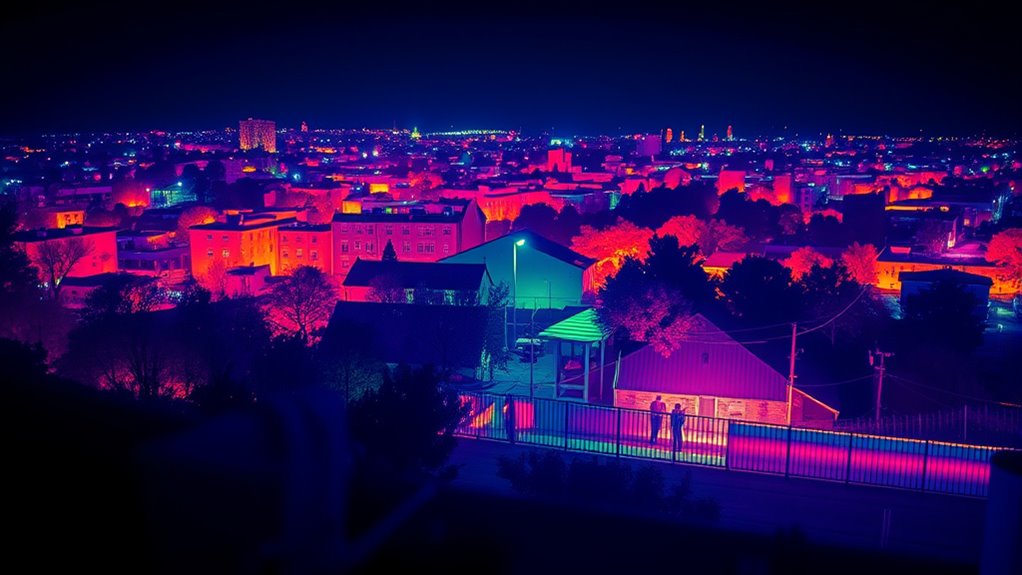
Multispectral and thermal imaging have become essential tools in modern security systems, offering capabilities beyond traditional cameras. These advanced technologies allow you to see clearly in challenging conditions, such as complete darkness or smoke-filled environments, where standard surveillance cameras often fall short. When it comes to night surveillance, thermal imaging is particularly invaluable. It detects heat signatures emitted by objects and individuals, enabling you to monitor areas even in total darkness or obscured by weather conditions like fog or rain. This ability considerably enhances your security coverage during nighttime hours, ensuring that potential threats don’t go unnoticed.
Sensor fusion is a vital aspect of multispectral and thermal imaging systems. It combines data from multiple sensors—such as visible spectrum cameras, infrared, and thermal detectors—creating a thorough picture of the monitored environment. By integrating these data streams, sensor fusion helps you distinguish between different objects more accurately. For instance, it can differentiate between a person and an animal or identify suspicious activity that might be missed by a single sensor type. This layered approach enhances detection accuracy, reduces false alarms, and provides a more dependable basis for quick decision-making. As a result, you gain a heightened situational awareness that’s essential for effective security management.
With multispectral imaging, you benefit from capturing data across various spectral bands, including visible, near-infrared, and shortwave infrared. This flexibility allows you to adapt your surveillance to different lighting conditions and environmental challenges. For example, in daytime, visible spectrum cameras provide clear images, while infrared sensors help during low-light or foggy conditions. Thermal imaging complements this by detecting heat differences, which is especially useful for night surveillance, where traditional cameras struggle. Additionally, advancements in Kia Tuning can optimize the performance of security vehicles used in patrols, ensuring they are equipped for high-performance tasks. By combining these technologies through sensor fusion, you create a sturdy security setup that operates seamlessly across diverse scenarios, giving you peace of mind that your perimeter is protected around the clock.
Furthermore, these systems are scalable and adaptable, making them suitable for a variety of security applications—from border control and critical infrastructure to private properties and commercial facilities. You can customize sensor configurations based on your specific needs, ensuring ideal coverage and performance. By leveraging multispectral and thermal imaging, you effectively extend your surveillance capabilities beyond what conventional cameras can achieve, especially in low-light environments. This combination of technologies empowers you to detect, identify, and respond to threats more swiftly and accurately, reinforcing your overall security posture.
Frequently Asked Questions
How Do Multispectral and Thermal Imaging Compare in Cost?
You’ll find that thermal imaging generally costs more upfront due to advanced sensor technology, while multispectral systems might be more budget-friendly but vary based on sensor quality. When doing a cost analysis, consider your security needs and long-term benefits. Thermal imaging excels in low-light conditions, which might justify higher costs, whereas multispectral options can offer versatile detection at a lower price, helping you stay within your budget considerations.
What Training Is Required to Operate These Imaging Systems?
Of course, operating these high-tech marvels requires more than just a finger on the trigger. You’ll need operator certification to prove you’re not a danger to yourself or others. Technical proficiency is essential, involving training on calibration, data interpretation, and system maintenance. Expect to spend time in hands-on courses or workshops, because mastering multispectral and thermal imaging isn’t just intuitive; it’s a skill that demands dedication and a dash of tech-savvy sophistication.
Can These Technologies Detect Concealed Threats Effectively?
You can effectively detect concealed threats with multispectral and thermal imaging, especially when combined with facial recognition and intrusion detection systems. These technologies allow you to see through concealments like clothing or packaging and identify hidden individuals or objects. Their high sensitivity to temperature differences and spectral signatures makes them reliable for security, ensuring you can spot threats quickly and accurately, even in challenging conditions or at night.
How Do Environmental Conditions Affect Imaging Performance?
Environmental conditions can profoundly impact imaging performance. Environmental interference like fog, rain, or dust can degrade sensor clarity and reduce detection accuracy. You need to guarantee proper sensor calibration to adapt to changing conditions, which helps maintain reliable imaging. Regular calibration and understanding environmental factors enable you to optimize multispectral and thermal imaging systems, ensuring they function effectively even under challenging weather or lighting situations.
Are There Privacy Concerns With Using Multispectral and Thermal Imaging?
You should be aware that multispectral and thermal imaging raise privacy implications because they can see through obstacles or detect individuals without their knowledge. Surveillance concerns increase as these technologies can capture detailed information beyond visible light, potentially infringing on personal privacy rights. It is crucial to balance security benefits with ethical considerations, ensuring proper regulations are in place to address privacy implications and prevent misuse of this powerful imaging technology.
Conclusion
Imagine standing guard with a superpower, seeing through darkness and obstacles that hide threats. Multispectral and thermal imaging give you that edge, turning shadows into clear threats. Like a lighthouse piercing fog, these technologies illuminate what’s unseen, enhancing security everywhere from airports to borders. With over 30% of security breaches going unnoticed in traditional systems, embracing these advanced tools isn’t just smart — it’s essential to stay ahead, ensuring safety in every corner.