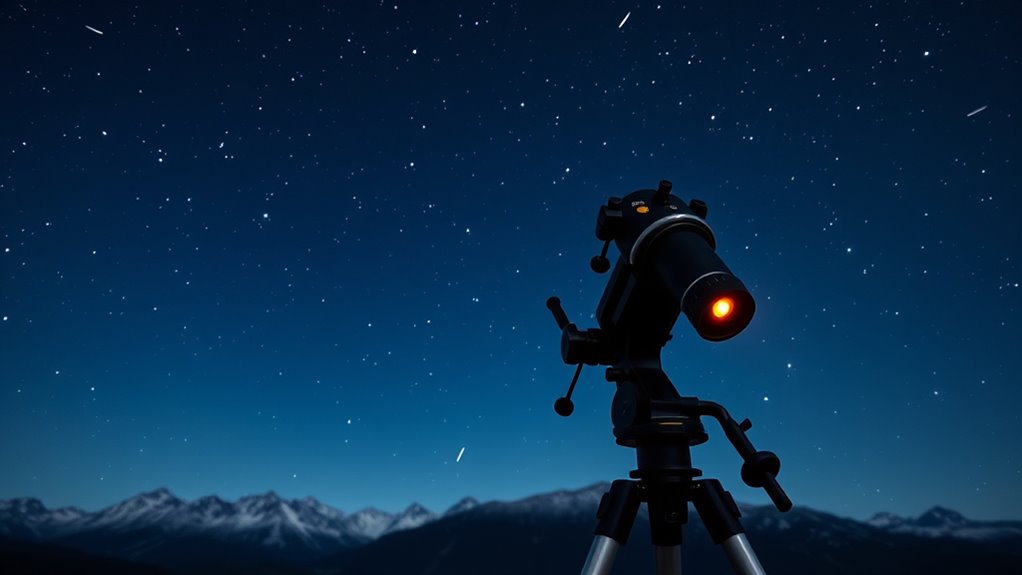

To get precise star tracking, you need to perform proper polar alignment. Start with your mount’s polar scope, locate Polaris, and center it in the reticle for a quick initial setup. Then, fine-tune the alignment by observing star drift over time, adjusting azimuth and altitude to match celestial movement. Combining these methods guarantees your mount follows stars accurately, preventing trails and blurry images. Keep exploring for more tips to perfect your alignment process.

Get the latest gadgets delivered free with Prime
- Fast, free delivery on millions of items
- Prime Video, Amazon Music and more included
- Member-only deals all year
Key Takeaways
- Use a polar scope to quickly align your mount with Polaris near the celestial north pole.
- Fine-tune alignment by observing star drift over time to improve tracking precision.
- Adjust azimuth and altitude based on star movement near the celestial pole for better accuracy.
- Combine initial polar scope alignment with drift alignment techniques for optimal star tracking.
- Practice patience and meticulous adjustments to prevent star trails and achieve high-quality astrophotography.
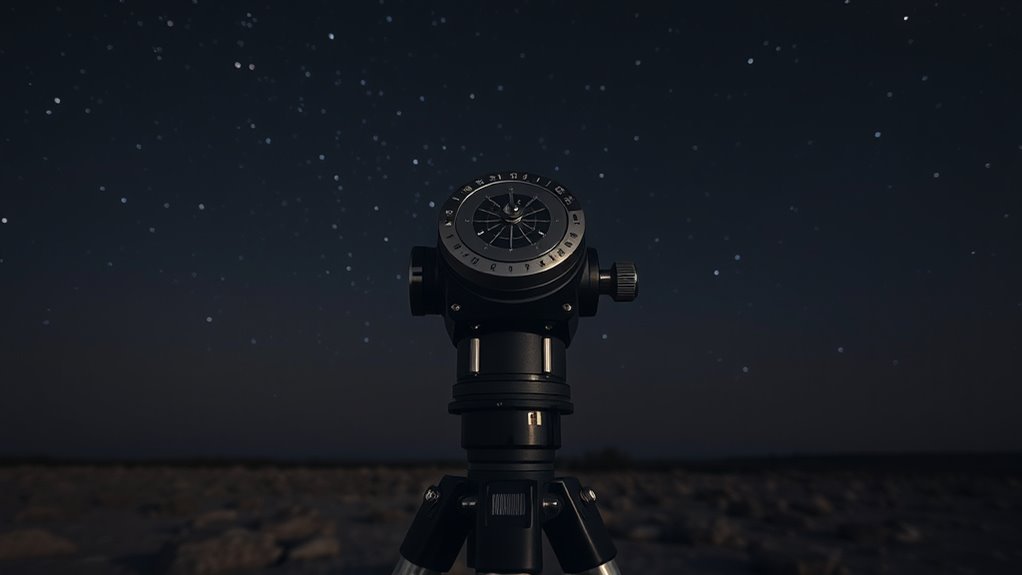
Proper polar alignment is essential for accurate star tracking, enabling your telescope to follow celestial objects smoothly across the night sky. When you set up your telescope, mastering polar alignment techniques becomes your first step toward successful astrophotography or detailed celestial observation. Without a precise alignment, your telescope’s mount won’t accurately track the stars, causing them to drift out of your field of view and compromising image quality. To avoid these issues, you need to understand and implement effective methods of celestial navigation that help you align your mount with Earth’s rotational axis.
Proper polar alignment ensures precise star tracking for successful astrophotography and celestial observation.
One of the most straightforward polar alignment techniques involves using a polar scope, which is built into many equatorial mounts. You start by locating Polaris, the North Star, which sits close to the celestial north pole. By centering Polaris within the reticle of your polar scope, you align your mount’s axis to point directly toward the celestial north pole. This method is quick and effective for casual stargazing, but keep in mind that Polaris is not exactly at the celestial north pole; it’s about 0.7 degrees away. To improve accuracy, you can fine-tune your alignment by adjusting for Polaris’s slight offset or use drift alignment, which involves observing star movement over a period to refine your mount’s positioning.
Another useful celestial navigation technique is the drift method. You point your telescope at a star near the celestial equator and observe its movement over time—if it drifts north or south, you adjust your mount’s azimuth accordingly. Similarly, by observing a star near the eastern or western horizon, you can tweak your altitude. This process requires patience but yields highly accurate results, especially for long-exposure astrophotography. It’s particularly valuable if Polaris is obscured or unsuitable for precise alignment.
Incorporating these polar alignment techniques into your routine will profoundly improve your star tracking accuracy. The key is patience and attention to detail. Take the time to fine-tune your mount’s alignment, as even minor discrepancies can cause star trails or blurred images. Remember, celestial navigation isn’t just about pointing your mount in the right direction but understanding how Earth’s rotation affects celestial objects. Using a combination of methods—initial rough alignment with a polar scope followed by drift adjustments—gives you the best chance at achieving precise polar alignment. With practice, these techniques become second nature, transforming your astrophotography sessions into more rewarding and successful endeavors.
As an affiliate, we earn on qualifying purchases.
Frequently Asked Questions
How Often Should I Realign My Telescope After Initial Setup?
You should realign your telescope on your equatorial mount whenever you notice star tracking issues, or about once a month for ideal performance. Environmental changes, like temperature shifts or minor bumps, can affect alignment. Regular checks ensure your star tracking remains accurate, especially during long astrophotography sessions. Staying attentive to tracking accuracy helps you capture sharp images and enjoy smooth celestial observations without constantly redoing the initial polar alignment.
Can I Perform Polar Alignment Without Special Equipment?
Yes, you can perform polar alignment without special equipment by using equipment alternatives and simple alignment techniques. You can rely on your regular binoculars or smartphone apps to help identify Polaris or other celestial objects. Techniques like the drift method or using the sun’s position can also guide you. While less precise, these methods are effective for casual stargazing or beginner astrophotography, making polar alignment accessible without specialized gear.
What Are Common Mistakes to Avoid During Polar Alignment?
To guarantee proper alignment accuracy, avoid common mistakes like rushing the process or not thoroughly calibrating your equipment. Double-check your mount’s settings and make sure your polar scope is correctly aligned. Keep the mount steady and avoid sudden movements, as they can disrupt the alignment. Regularly verify your calibration to maintain precision. By paying attention to these details, you’ll improve your star tracking and get clearer astrophotography results.
How Does Temperature Affect Polar Alignment Accuracy?
Temperature effects can substantially impact your polar alignment precision because as temperatures fluctuate, materials expand or contract, causing slight shifts in your mount and polar scope. This instability makes it harder to maintain accurate alignment over time. To combat this, you should regularly check your alignment, allow your equipment to reach thermal equilibrium before starting, and use stable, thermally matched accessories to minimize the influence of temperature changes on your star tracking accuracy.
Is Polar Alignment Necessary for Astrophotography?
Yes, polar alignment is essential for astrophotography because it guarantees your mount is properly aligned with Earth’s axis, aiding celestial navigation. When your mount is accurately aligned, your star tracking becomes precise, reducing star trails and blurriness. Proper mount alignment minimizes tracking errors, especially over long exposures. Without it, your images will suffer from star movement, making polar alignment a critical step for capturing sharp, high-quality astrophotographs.
equatorial mount for astrophotography
As an affiliate, we earn on qualifying purchases.
As an affiliate, we earn on qualifying purchases.
Conclusion
Mastering polar alignment transforms your star tracking from a shaky mess into a celestial symphony. With perfect alignment, your telescope will dance flawlessly with the stars, making every shot breathtakingly sharp and detailed. Imagine capturing galaxies and nebulae as if you’re holding the universe in your hands—no more frustrating blurs or missed shots. Once you get it right, you’ll wonder how you ever managed without this skill. It’s your secret weapon for stellar astrophotography success!
drift alignment tools for telescopes
As an affiliate, we earn on qualifying purchases.
As an affiliate, we earn on qualifying purchases.
As an affiliate, we earn on qualifying purchases.
Halloween Picks
halloween
As an affiliate, we earn on qualifying purchases.