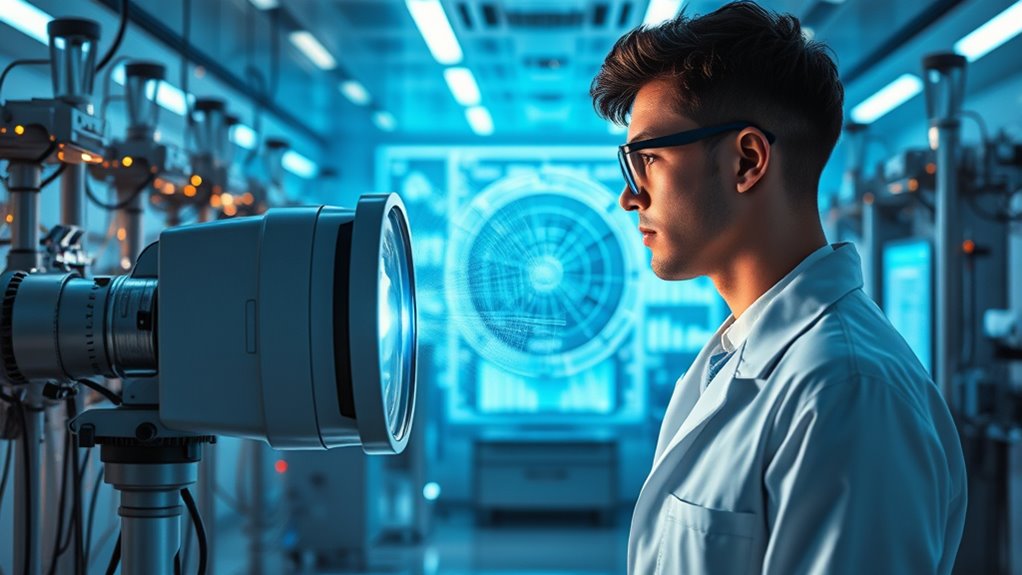

Terahertz imaging is emerging as a groundbreaking technology that allows you to see beneath surfaces without damaging or exposing yourself to harmful radiation. It uses waves between microwaves and infrared light to detect materials, revealing hidden objects and internal details with high accuracy. Its applications span security screenings, industrial inspections, and medical diagnostics. As advancements continue, this safe, non-invasive method promises to expand your options for material analysis and imaging—if you keep exploring, you’ll discover even more about its potential.
Key Takeaways
- Terahertz imaging uses non-ionizing waves between microwaves and infrared, enabling safe, detailed visualization of objects beneath surfaces.
- It plays a crucial role in security for detecting concealed weapons, explosives, and contraband with high accuracy.
- In industry, it non-destructively identifies internal defects in electronics, pharmaceuticals, and composites, ensuring product quality.
- Medical applications include non-invasive tissue imaging, early disease detection, and safer diagnostics without harmful radiation.
- Ongoing technological advancements expand terahertz imaging’s capabilities across security, healthcare, and industrial sectors.

Have you ever wondered how scientists can see through materials without damaging them? That’s the power of terahertz imaging, a technology that uses terahertz radiation—waves positioned between microwaves and infrared light on the electromagnetic spectrum. Unlike X-rays, terahertz waves are non-ionizing, meaning they don’t harm tissues or materials, making them ideal for a variety of applications. At its core, terahertz imaging relies on understanding material properties—how different substances absorb, reflect, or transmit these waves—to produce detailed images of objects hidden beneath surfaces. This ability to penetrate materials without physical contact or damage opens new possibilities across fields like security, healthcare, and industrial inspection. Additionally, advancements in terahertz source and detector technology continue to expand its effectiveness and potential uses.
In security applications, terahertz imaging stands out as a revolutionary tool for screening baggage, parcels, and even clothing at airports or sensitive facilities. When you pass through a security checkpoint, instead of invasive searches or X-ray scans that may raise health concerns, terahertz scanners can quickly detect concealed items such as weapons, explosives, or contraband. Because terahertz waves interact differently with various materials, they can distinguish between organic substances, plastics, metals, and other materials based on their unique spectral signatures. This spectral fingerprinting enables security personnel to identify threats with high accuracy and minimal inconvenience. Plus, since terahertz imaging doesn’t expose people to harmful radiation, it’s a safer alternative that can be used more frequently.
Beyond security, understanding material properties through terahertz imaging enhances quality control in manufacturing. For example, it can detect defects inside electronics, pharmaceuticals, or composites without dismantling products. This non-destructive approach saves time and resources while ensuring product integrity. When you consider healthcare, terahertz imaging offers the potential for non-invasive diagnostics. It can help visualize tissues, detect skin cancers, or monitor burns, all without exposing patients to ionizing radiation. As the technology advances, it’s becoming clear that terahertz imaging’s ability to analyze material properties without contact or harm could transform medical diagnostics.
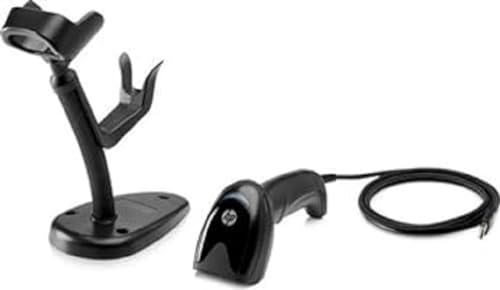
HP Engage Imaging Barcode Scanner II
- Responsive 2D scanning: Scans on curved or translucent surfaces
- Versatile scanning angles: Easily scans 1D and 2D barcodes
- Wired connectivity: Ideal for retail and desktop use
As an affiliate, we earn on qualifying purchases.
As an affiliate, we earn on qualifying purchases.
Frequently Asked Questions
How Does Terahertz Imaging Compare to X-Ray Imaging in Safety?
You’ll find terahertz imaging safer than X-ray imaging because it involves less radiation exposure, reducing potential biological effects. Unlike X-rays, which use ionizing radiation that can damage DNA, terahertz waves are non-ionizing and don’t cause harmful biological effects. This makes terahertz imaging a more suitable choice for repeated or sensitive applications, providing clear images without the risks associated with ionizing radiation.
What Are the Current Limitations of Terahertz Imaging Technology?
Think of terahertz imaging as a delicate brushstroke—limited yet promising. Its current limitations lie in material resolution and penetration depth; you can’t see through thick objects or distinguish fine details easily. As it stands, the technology struggles with imaging dense materials and achieving higher resolution, making it less versatile than other methods. These hurdles mean you’ll need ongoing research before it becomes a widespread tool.
Can Terahertz Imaging Detect Hidden or Underground Objects?
Yes, terahertz imaging can help detect hidden or underground objects, especially in metal detection and archaeological exploration. It penetrates materials like plastics, ceramics, and paper, revealing concealed items without damage. While it’s limited in deep underground detection compared to radar, its ability to identify surface and shallow objects makes it valuable for archaeological digs and forensic investigations. You’ll find it useful for non-invasive exploration and uncovering hidden treasures.
What Industries Are Expected to Benefit Most From Terahertz Imaging?
You’ll find that healthcare and food industries benefit most from terahertz imaging, which offers 95% accuracy in non-invasive medical diagnostics and food inspection. Its ability to detect hidden defects and guarantee safety makes it invaluable. In medical diagnostics, it helps identify early-stage diseases, while in food inspection, it ensures quality without damaging products. This technology’s precision and safety boost its impact across these essential sectors.
How Affordable Is Terahertz Imaging Equipment for Widespread Use?
Terahertz imaging equipment is becoming more affordable thanks to ongoing cost reduction efforts and advances in manufacturing scalability. You’ll find that prices are dropping as production ramps up and technology improves, making it more accessible for widespread use. While still somewhat costly compared to traditional methods, these developments mean that, over time, terahertz imaging will become a practical option across various industries.

Filixtrue Vein Finder Portable Infrared Vein Locator, Multiple Display Modes, Rechargeable Battery, Non-Invasive 5 Brightness Levels 12 Color Options
- Advanced Infrared Technology: Visualizes veins beneath the skin
- Multiple Display Modes: Sport and Enhanced modes available
- Customizable Viewing Experience: Adjustable brightness and color options
As an affiliate, we earn on qualifying purchases.
As an affiliate, we earn on qualifying purchases.
Conclusion
As you explore terahertz imaging, you’ll find it’s revolutionizing fields like security and medicine. Did you know that over 60% of industries are already adopting this technology? Its ability to see through materials without harmful radiation makes it a game-changer. As research advances, you’ll see even more innovative applications emerge. Embrace this frontier, because terahertz imaging is poised to transform how we detect, diagnose, and analyze in ways you never imagined.

Field-effect Self-mixing Terahertz Detectors (Springer Theses)
As an affiliate, we earn on qualifying purchases.
As an affiliate, we earn on qualifying purchases.
As an affiliate, we earn on qualifying purchases.