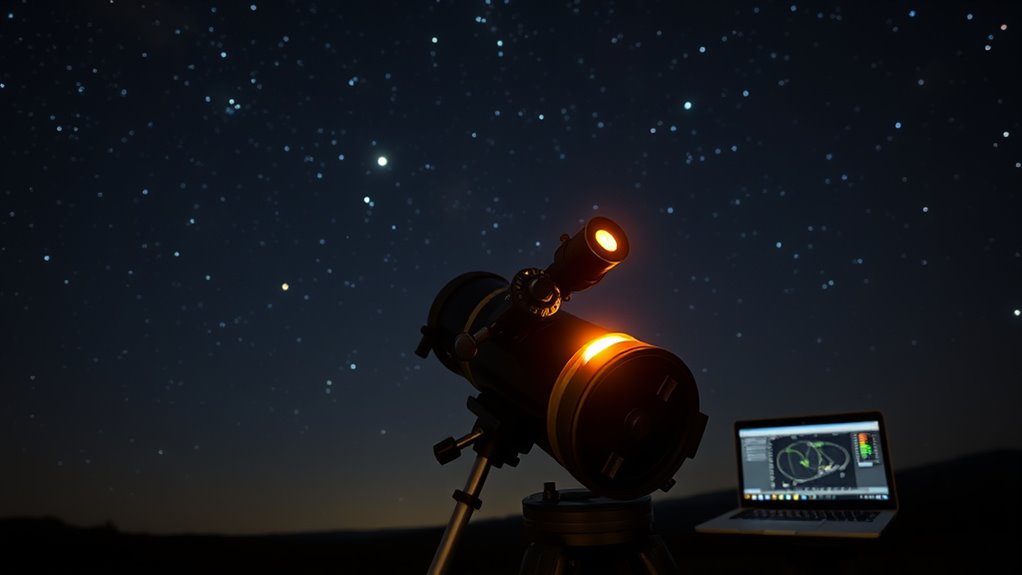
To guarantee accurate tracking with your telescope, you need to perform proper polar alignment by aligning your mount with Earth’s rotational axis. In the northern hemisphere, locate Polaris and adjust your mount until the star remains stationary in the eyepiece, while in the southern hemisphere, find the south celestial pole using star charts or alignment tools. Precise alignment keeps your telescope tracking smoothly during long exposures. Keep exploring to find out how to perfect your polar alignment step-by-step.
Key Takeaways
- Locate the celestial pole (Polaris in the north, approximate in the south) as a reference point for alignment.
- Adjust the mount’s altitude and azimuth to align the mount’s axis with the celestial pole precisely.
- Use star charts or polar alignment tools to confirm accurate positioning of the mount relative to the celestial pole.
- Center Polaris or the south celestial pole in the eyepiece or camera for stable, precise alignment.
- Confirm that star movement appears as a circle around the pole, indicating correct polar alignment for accurate tracking.
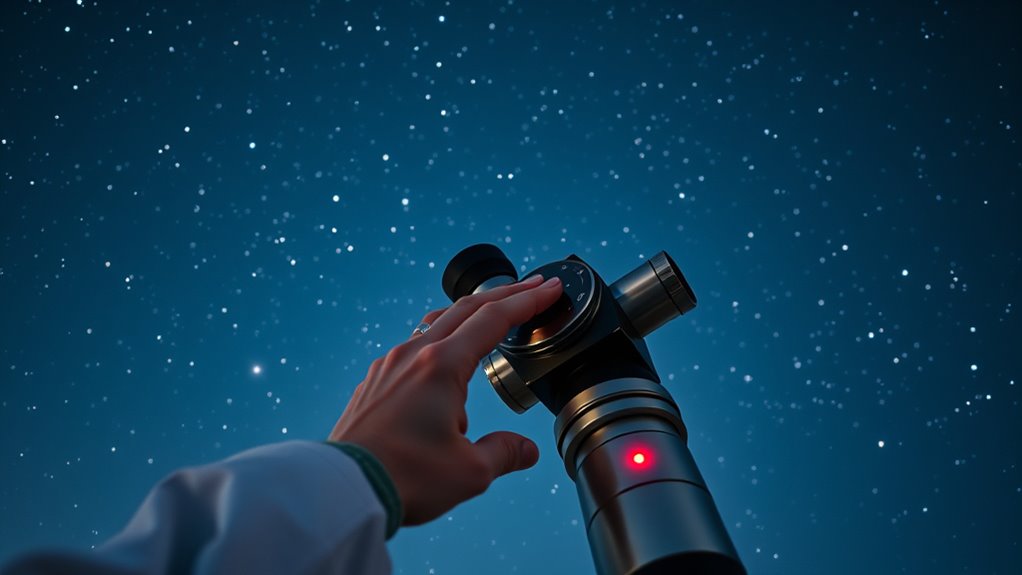
Have you ever wondered how astronomers keep their telescopes precisely aligned with the night sky? The secret lies in a process called polar alignment, which involves aligning your telescope‘s mount with the Earth’s rotational axis. To do this accurately, you need to understand the significance of the celestial poles. These are the two points in the sky where Earth’s axis intersects the celestial sphere—north and south celestial poles. When your telescope is properly aligned with the celestial pole in your hemisphere, it can track the star movement smoothly as the Earth rotates. This alignment allows your mount’s tracking to match the apparent motion of celestial objects, minimizing star trails and ensuring clear, sharp images over extended periods.
The key challenge in polar alignment is pinpointing the celestial pole, especially since it isn’t visible to the naked eye. In the northern hemisphere, you’ll aim toward Polaris, the North Star, which is situated very close to the north celestial pole. Polaris serves as a practical guide because it remains nearly stationary in the sky as other stars circle around it. By centering Polaris in your eyepiece or camera, you align your mount with the north celestial pole. In the southern hemisphere, there’s no bright star like Polaris, so you need to use star charts or polar alignment tools that help you locate the south celestial pole, which is near the constellation Octans.
Once you’ve identified the celestial pole, you adjust your mount’s altitude and azimuth to align with it. This process involves fine-tuning the mount’s position until the star movement appears to circle around the celestial pole rather than drifting in unexpected directions. When you achieve this, your telescope is effectively “polar aligned.” This alignment ensures that as the Earth turns, your mount’s motorized tracking system can follow celestial objects accurately without requiring constant manual adjustments. As a result, long exposures become possible without star trails, and your astrophotography or visual observations become much clearer.
Star movement across the sky is predictable once your mount is aligned properly. It appears as a slow, circular motion around the celestial pole. Without correct polar alignment, stars will drift out of the field of view, and images will blur over time. With precise polar alignment, your telescope can compensate for Earth’s rotation, keeping objects centered and steady in your view. This process is vital for astrophotography and detailed observation, where even slight misalignments can ruin images or make tracking difficult. By understanding the importance of celestial poles and star movement, you can master polar alignment, ensuring your telescope remains accurately pointed and your astronomical observations are as precise as possible. Proper telescope mount alignment is essential for achieving optimal tracking accuracy and image quality.
Frequently Asked Questions
What Tools Are Best for Beginner Polar Alignment?
You should start with a good polar scope, as it’s the easiest tool for beginners to align your equatorial mount accurately. Many mounts come with built-in polar scopes, which simplify the process. You can also use smartphone apps designed for polar alignment, which guide you step-by-step. These tools make it easier to find Polaris and align your mount properly, improving tracking and image quality with minimal hassle.
How Often Should I Realign My Telescope?
Think of your telescope as a skilled dancer; it needs regular guidance to stay in perfect step. You should check and realign every few weeks or after major transportation to maintain alignment accuracy and tracking stability. Environmental changes like temperature shifts or bumps can throw off your setup. Regular realignment guarantees your starry journey remains smooth, keeping your celestial dance flawless and your images sharp.
Can Polar Alignment Be Automated?
Yes, polar alignment can be automated using automation techniques like electronic polar scopes, software-assisted alignment, or motorized mounts. These tools improve alignment accuracy and save you time. You simply follow the guided processes or use software to fine-tune your setup, ensuring precise polar alignment without manual adjustments. Automation makes it easier to achieve and maintain accurate tracking, especially during long astrophotography sessions or extended observing nights.
What Are Common Mistakes During Polar Alignment?
You often make mistakes during mount alignment by rushing the celestial navigation process or skipping careful adjustments. Make certain your mount is level, and double-check the polar scope for proper alignment. Avoid misaligning the polar axis, which can throw off your tracking. Take your time, verify your setup, and use precise celestial navigation to improve accuracy. Correcting these common errors helps achieve better polar alignment and sharper astrophotography results.
How Does Latitude Affect Polar Alignment Procedures?
Your latitude profoundly affects polar alignment procedures because it determines how you adjust your mount’s celestial coordinate system. At different latitudes, you need to perform latitude adjustments to align the mount’s polar axis with Earth’s rotational axis accurately. Higher latitudes require more precise adjustments, while lower latitudes involve different celestial coordinate considerations. Proper latitude adjustment ensures your mount tracks celestial objects smoothly, minimizing errors during long exposures.
Conclusion
Now, as you perfect your polar alignment, you’ll find it’s no coincidence that your images become sharper and tracking smoother. When everything lines up just right, it feels like the universe is subtly guiding your telescope. That moment when the stars stay steady in your view isn’t luck — it’s the universe’s way of rewarding your patience and precision. Keep practicing, and you’ll enjoy many clear, stunning nights under the stars, just as nature intended.