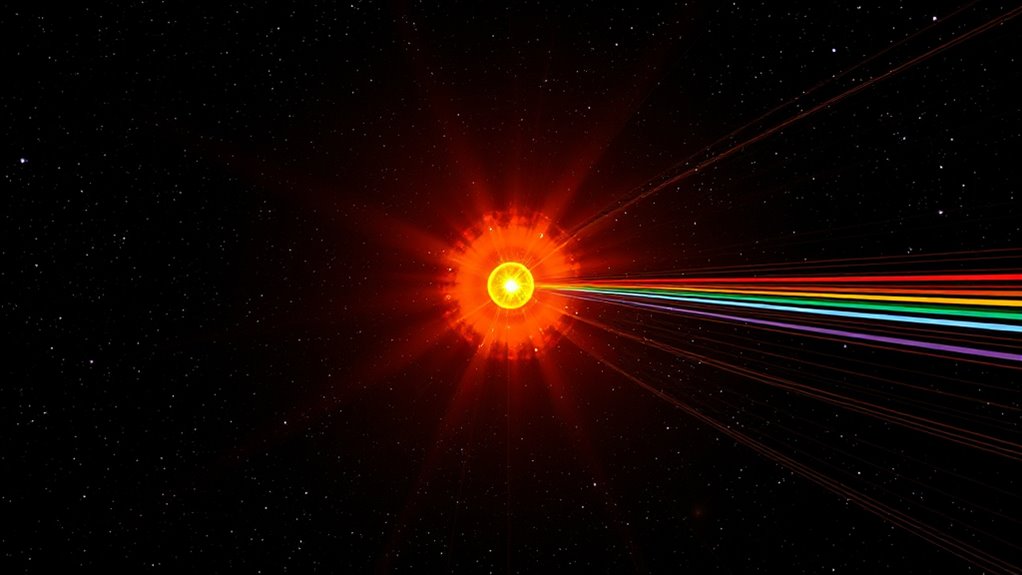

Spectral analysis lets you determine a star’s composition and temperature by examining its absorption lines. These dark lines in the spectrum act as fingerprints for elements like hydrogen, helium, and metals, showing which elements are present in the star’s atmosphere. The pattern and strength of these lines reveal the star’s chemical makeup and its surface temperature. Keep exploring, and you’ll uncover how scientists interpret these spectral clues to understand stellar properties better.
Key Takeaways
- Analyze dark absorption lines in stellar spectra to identify specific elements present in the star’s atmosphere.
- Examine the pattern and strength of spectral lines to determine the star’s chemical composition and elemental abundances.
- Assess spectral line widths and profiles to infer physical conditions like temperature and atmospheric density.
- Use the presence of temperature-sensitive lines, such as hydrogen Balmer lines, to estimate stellar temperature.
- Understand physical mechanisms like thermal motion and pressure broadening that influence spectral features and inform about stellar properties.
Spectral analysis of stars is a powerful tool that astronomers use to uncover the secrets of the universe. By examining the light emitted from a star, you can determine its composition, temperature, and even its evolutionary stage. One of the key concepts in this process is stellar classification, which categorizes stars based on their spectral characteristics. When you analyze a star’s spectrum, you notice dark absorption lines that correspond to specific elements. These lines serve as fingerprints, allowing you to identify the elements present in the star’s atmosphere. The pattern and strength of these lines reveal not only what the star is made of but also provide clues about its physical conditions. Additionally, understanding the underlying physical mechanisms behind spectral features can help you interpret the data more accurately, such as the effects of stellar activity on spectral line profiles.
Another important aspect of spectral analysis involves spectral line broadening, a phenomenon that occurs due to various physical effects within the star. When you observe broadened spectral lines, it indicates that the star’s atmosphere is experiencing certain dynamics. For instance, thermal motion causes atoms to move at different speeds, which broadens the lines due to the Doppler effect. Similarly, rapid rotation of the star can cause lines to spread out because different parts of the star’s surface are moving toward or away from you at different velocities. Pressure broadening, on the other hand, happens when high particle densities in the star’s atmosphere cause collisions that disturb the energy levels of atoms, leading to wider spectral lines. Recognizing the causes behind line broadening helps you interpret the physical conditions of the star more accurately. Exploring the physical processes involved in spectral line formation enhances your understanding of stellar atmospheres and their properties.

Spectroscopy: The Key to the Stars: Reading the Lines in Stellar Spectra (The Patrick Moore Practical Astronomy Series)
As an affiliate, we earn on qualifying purchases.
As an affiliate, we earn on qualifying purchases.
Frequently Asked Questions
How Do Spectral Lines Vary With Stellar Age?
As a star ages, spectral lines change due to stellar evolution, indicating shifts in temperature and composition. You’ll notice spectral shifts: young stars show lines of hotter, more ionized elements, while older stars display lines from cooler, less ionized material. These variations help you track stellar evolution, revealing how stars develop over time. By analyzing spectral lines, you can determine a star’s age and its evolutionary stage.
Can Spectral Analysis Detect Exoplanets?
Yes, spectral analysis can detect exoplanets through methods like the radial velocity technique, which observes tiny shifts in stellar atmospheres caused by the gravitational pull of orbiting planets. As the exoplanet influences the star’s motion, you notice changes in spectral lines. This method allows you to identify exoplanets indirectly, revealing their presence by analyzing the subtle Doppler shifts in the star’s spectrum.
What Are the Limitations of Current Spectral Technologies?
You face limitations in current spectral technologies due to instrument sensitivity and spectral resolution. Low sensitivity restricts your ability to detect faint signals from distant stars or planets, while inadequate spectral resolution can blur spectral lines, making it hard to distinguish between different elements or molecules. Improving these aspects is vital for more precise analysis, enabling you to uncover detailed compositions and temperature variations with greater accuracy.
How Does Magnetic Activity Affect Stellar Spectra?
Magnetic activity influences stellar spectra by causing variations through magnetic cycles and starspots. When magnetic fields are strong, they create starspots that block light, leading to absorption line changes. Magnetic cycles can cause spectral line shifts and intensity fluctuations over time. These effects can complicate spectral analysis, making it harder to accurately determine a star’s composition and temperature, especially if magnetic activity varies markedly during observations.
Are There Stars With Unusual Spectral Signatures?
Like a star wearing a cosmic disguise, some stars show unusual spectral signatures, standing out from typical patterns. These spectral anomalies often result from intense stellar winds or magnetic activity that alter their light. Such stars may have peculiar chemical compositions or energetic phenomena that create unique spectral lines, revealing secrets about their nature. Spotting these anomalies helps you understand stellar evolution and the dynamic processes shaping our universe.

Five Star Composition Book + Study App, 4 Pack, Wide Ruled Paper, 7-1/2" x 9-3/4", 80 Sheets, Forest Green, Tidewater Blue, Fire Red and Harvest Yellow (950033B-ECM)
As an affiliate, we earn on qualifying purchases.
As an affiliate, we earn on qualifying purchases.
Conclusion
By examining a star’s spectrum, you unveil the secrets of its composition and temperature—like reading an ancient, celestial manuscript. Spectral analysis reveals the universe’s hidden stories, turning distant lights into familiar faces. As you decode these stellar signatures, remember: each spectrum is a cosmic poem waiting to be understood. So, next time you look up at the night sky, know that you hold the key to unlocking its deepest mysteries—just like a starry detective.
hydrogen Balmer line educational model
As an affiliate, we earn on qualifying purchases.
As an affiliate, we earn on qualifying purchases.

Stellar Spectral Classification (Princeton Series in Astrophysics)
As an affiliate, we earn on qualifying purchases.
As an affiliate, we earn on qualifying purchases.